From 15 October 2026, UPI MDR applies to a defined slice of merchant payments: a merchant discount rate of 0.4% on person-to-merchant (P2M) UPI payments above ₹2,000, capped at ₹300 for payments of ₹75,000 and above. The charge is paid by the merchant to its acquiring bank. The payer, according to the official FAQs, pays nothing extra.
The rules are set out in a set of frequently asked questions dated 15 September 2026 and published by both the National Payments Corporation of India and the Department of Financial Services in the Ministry of Finance. They answer most of the questions a shopkeeper or a customer is likely to have, but a few categories are described more loosely than others. Here is what the document says, and where it leaves room for doubt.
What the 0.4% applies to
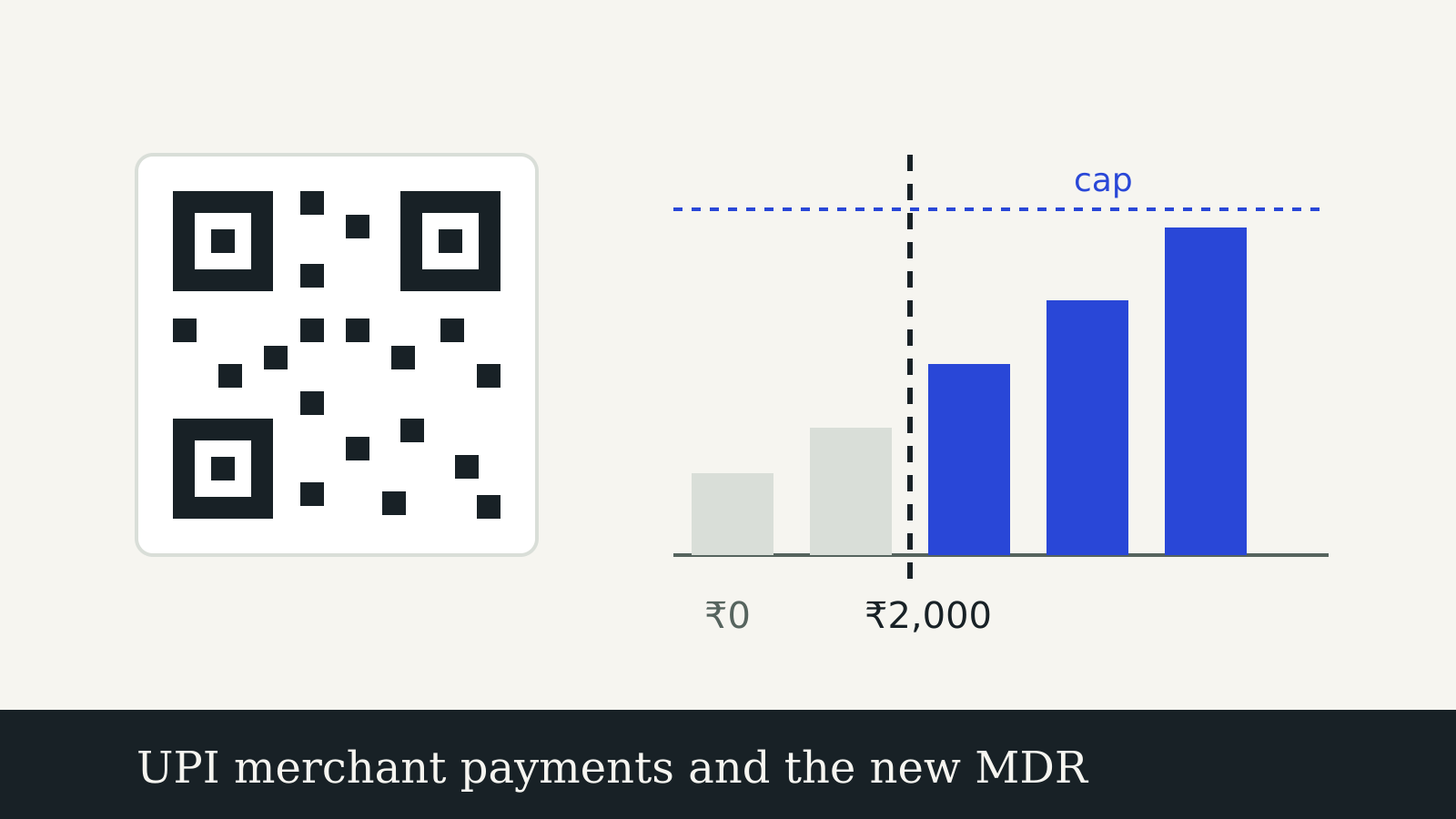
The standard rate covers a payment from a person to a merchant account when the single payment is above ₹2,000. A payment of exactly ₹2,000 or less carries no MDR, and the FAQs say such payments make up more than 95% of P2M volume.
The fee is calculated on the full payment, not just the part above ₹2,000. The worked examples in the FAQs are simple:
| Payment to the merchant | MDR rate | MDR paid by the merchant |
|---|---|---|
| ₹2,000 | — | ₹0 |
| ₹3,000 | 0.4% | ₹12 |
| ₹50,000 | 0.4% | ₹200 |
| ₹75,000 and above | Fixed | ₹300 |
Source: NPCI and Department of Financial Services FAQs, 15 September 2026. A ₹1,00,000 payment would come to ₹400 at 0.4%; the cap brings it down to ₹300.
The ₹300 cap and the 0.4% rate meet exactly at ₹75,000, since 0.4% of ₹75,000 is ₹300. Above that, the merchant’s cost stays flat however large the payment.
Three lower rates
Not every merchant pays 0.4%. The FAQs set out separate treatment for three groups.
Essential and public services. For railways, telecom services, insurance premiums and fuel, “among others”, a flat MDR of ₹5 per transaction applies to payments above ₹2,000. The FAQs place electricity, municipal water and piped gas bills in the same flat ₹5 category. At a petrol pump, a ₹1,500 fill carries no MDR and a ₹2,500 fill carries ₹5.
Capital markets. Payments to mutual funds, SEBI-registered stockbrokers, securities dealers and investment platforms carry 0.02% of the transaction value, again capped at ₹300.
Education. School and college fees above ₹2,000 are said to benefit from “flat-fee structures or capped processing rates”. Unlike the other two groups, this answer gives no figure, so schools and parents will have to wait for the acquiring bank’s actual pricing to know the number.
What stays free
The FAQs are emphatic on the customer side. Person-to-person transfers remain free for both sender and receiver, whatever the amount, and that includes transfers between a person’s own accounts. There is no monthly quota of free payments. UPI apps are explicitly barred from adding a platform fee to UPI payments.
Recurring payments set up as UPI AutoPay mandates, such as utility bills, OTT subscriptions and recurring investments, “do not carry prescribed MDR transaction charges”, according to the same document.
Payments made through RuPay credit cards linked to UPI, or through pre-sanctioned credit lines, are treated separately. The FAQs say these follow credit card rules and that the new MDR applies to account-to-account UPI payments.
The FAQs mention that banks and NPCI also apply daily caps on the amount a person can send, describing them as risk controls rather than charges. Those limits differ by category and bank; our UPI limit tracker lists them from official sources.
Small merchants: the P2PM exemption
The biggest relief is for small shops and street vendors. Merchants onboarded under NPCI’s person-to-person-merchant (P2PM) category, who receive up to ₹1 lakh a month through UPI QR codes directly into their own bank accounts, stay at zero MDR, even when an individual payment is above ₹2,000. GST registration is not needed to qualify, and existing QR stands and soundboxes keep working without changes.
The exemption is not permanent for every small merchant. According to the FAQs, acquiring banks track inward UPI credits, and a P2PM merchant who receives more than ₹1 lakh a month for three consecutive months is moved to the regular P2M category, where the MDR rules above apply.
Can a shop pass the charge on?
No. “Merchants on-boarded cannot pass on MDR charges to customers while accepting payments through UPI,” the FAQs state, and customers should pay only the posted price. The document argues that the rate is low enough for merchants to absorb as an ordinary operating cost, and compares it with credit card MDRs, which it puts at 1.5% to 2.5%, and debit card MDRs capped at up to 0.90%.
For customers, the practical check from 15 October is simple. If a counter asks for an extra amount because you are paying by UPI, that is not something the framework provides for. The FAQs advise relying on updates from the Ministry of Finance, the RBI, NPCI and the Press Information Bureau rather than forwarded messages.
Why the government says it is needed
The FAQs give the official reasoning. MDR revenue is to be shared only within the UPI ecosystem and spent on infrastructure resilience, cybersecurity, fraud detection and customer service. The document cites industry estimates that running UPI costs around ₹20,000 crore a year; that is an estimate, not an audited figure. It also notes the scale involved: 2,451 crore UPI transactions worth ₹29.9 lakh crore in August 2026 alone, a growth story we examined in UPI’s FY2026 numbers.
A share of the money is meant for a dedicated fund to expand UPI acceptance among small merchants in Tier 3 to 6 centres, including the North-East, Jammu and Kashmir and Ladakh. Its detailed framework is to be finalised with the RBI within three months of the FAQs, so its rules are not yet public.
What is still open
Three things are worth watching after 15 October. The FAQs leave the operational parameters, fee distribution and category caps to the UPI and Services Steering Committee, which NPCI heads, so the list of ₹5 categories may be refined. The education rate has no published number. And the small-merchant fund has a deadline but no rulebook yet.
For a merchant, the immediate question is which category the acquiring bank has placed the account in. For a customer, nothing changes at the scanner: the route a QR payment takes is the same, and the price on the bill should be the price paid.
Questions
Who pays UPI MDR?
The merchant pays it to its acquiring bank. The FAQs say customers are not charged and merchants cannot pass the MDR on.
Is a ₹2,000 payment charged?
No. Only P2M payments above ₹2,000 attract the standard 0.4% MDR.
Do transfers to friends and family attract MDR?
No. Person-to-person UPI transfers, including self-transfers, remain free for both sides.
Does a small vendor pay MDR on a ₹5,000 payment?
Not if the vendor is in the P2PM category, receiving up to ₹1 lakh a month through UPI QR into a personal account. A vendor above that level for three consecutive months moves to the P2M category.