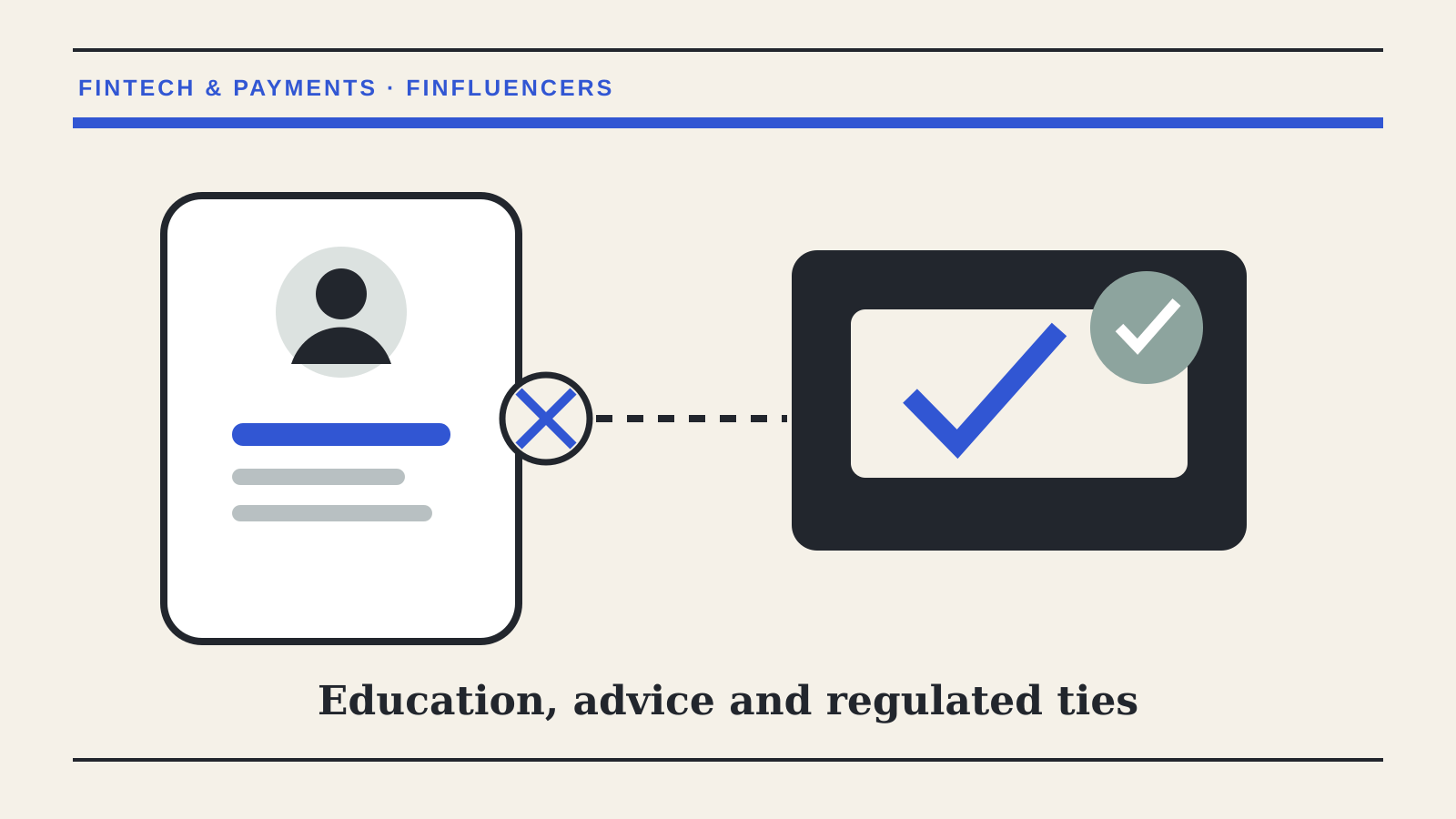
SEBI’s finfluencer rules draw a line between general investor education and regulated securities advice. The key question is not whether a creator uses social media, but whether the activity amounts to advice, recommendations or return claims — and whether a regulated market participant is associating with that person.
What SEBI’s October 2024 circular says
On 22 October 2024, the Securities and Exchange Board of India issued a circular covering associations between regulated persons and certain other people. It says a person regulated by SEBI, including its agents, should not have a direct or indirect association with someone who:
- provides securities advice or recommendations without being registered with, or otherwise permitted by, SEBI; or
- makes explicit or implicit claims about returns or performance in relation to securities without SEBI’s permission.
The restriction reaches transactions involving money, client referrals, information-technology interactions and similar arrangements. Existing contracts were given three months to end. A separate carve-out applies to associations through a “specified digital platform”, as defined by SEBI.
That makes this more precise than a blanket ban on financial creators. A licensed intermediary must examine who it is paying, referring clients to, sharing systems with or otherwise supporting.
Education is not automatically advice
The circular preserves room for investor education. A person who is solely engaged in education may be associated with a regulated entity, provided that person does not cross into the prohibited activities.
The boundary depends on the substance. A lesson explaining what an index fund is, how a demat account works or why diversification matters can remain educational. A post telling followers to buy a named security, giving personalised allocations or implying guaranteed returns moves toward activity that may require registration or permission.
A disclaimer such as “for education only” does not change what the post actually does. The words, examples, commercial arrangement and call to action all matter.
A practical way to classify a post
| Content | Typical signal | What to verify |
|---|---|---|
| General education | Explains a concept without a buy/sell call | No disguised recommendation or return claim |
| Security-specific view | Names a security and suggests action | Whether the person is registered or permitted |
| Personalised advice | Uses a reader’s goals, income or risk | Investment-adviser registration and scope |
| Performance promotion | Promises, projects or implies returns | Evidence, permission and applicable advertising rules |
| Paid association | Referral, sponsorship or shared commercial benefit | Whether the regulated entity may associate with the creator |
This table is a reading aid, not a legal test. A post can combine more than one category.
What regulated firms should check
A bank, broker, exchange, mutual fund or other regulated participant should not treat follower count as due diligence. Before an association, the firm should identify the person’s exact activity, registration status, claims, referral mechanics and any technology or data access.
Readers can use SEBI’s public intermediary records to verify whether someone appears in the relevant category. Registration is not a general badge for every financial statement: it has a category, a legal entity and a scope.
Payment checks matter too. Our guide to SEBI’s valid UPI handle system explains a separate verification tool for payments to registered intermediaries. It does not authenticate every creator, tip or social-media account.
What readers should watch for
Be cautious when a creator:
- gives an urgent buy or sell instruction without explaining status or risk;
- presents past performance as a dependable future outcome;
- sends followers to a private messaging group for “sure-shot” calls;
- asks for money through an unrelated account; or
- uses a disclaimer while continuing to give specific recommendations.
If the pitch also asks you to install an app, transfer crypto or keep the conversation secret, review our guides to crypto scams in India and digital arrest scams. Those are separate fraud patterns, but the same rule helps: verify the institution and the payment route independently.
What changed — and what did not
The October 2024 circular formalised how regulated entities must handle associations. It did not turn every discussion of markets into licensed advice, and it did not make a social-media profile self-validating. SEBI published a further clarification on 29 January 2025, so firms and creators should read the current circular set rather than rely on summaries.
The safe takeaway is narrow: education remains possible, but commercial ties to unregistered advice, recommendations or performance claims can create a compliance problem for the regulated entity.