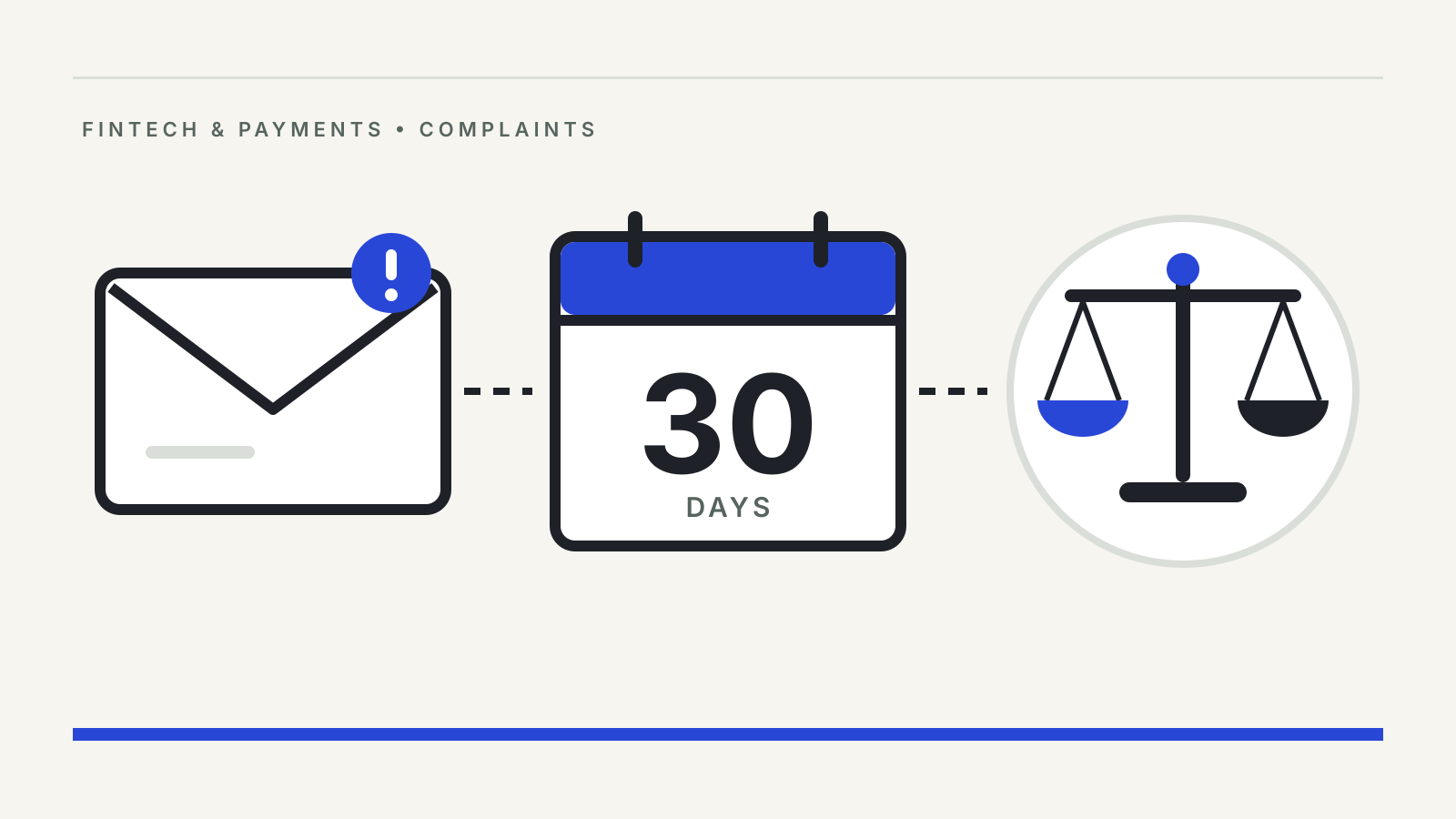
An RBI Ombudsman complaint is the second step, never the first. You have to write to your bank, NBFC or wallet company first, and you can go to the Reserve Bank of India only after it has rejected the complaint, given a reply you are unhappy with, or stayed silent for 30 days.
The rules changed this year. The Reserve Bank – Integrated Ombudsman Scheme, 2026 (RB-IOS, 2026) came into force on 1 July 2026 and replaced the 2021 scheme. The biggest practical change is the deadline: under the RBI’s FAQs on the new scheme, updated as on 1 July 2026, a complaint must reach the Ombudsman within 90 days of the bank’s last reply or of the waiting period running out. Complaints received before 1 July 2026 are still handled under the 2021 scheme.
Filing costs nothing. The FAQs say there is no fee for filing or resolving a complaint and that you need not pay any agency to file it for you.
Step 1: complain to the bank in writing
Use the bank’s grievance form, email or branch complaint channel, and keep the acknowledgement or complaint number. The RBI asks for that number, its date and a copy of the complaint when you escalate, so a phone call with no record is a weak start.
State what happened, the account, card, loan or transaction involved, the date, the amount and the outcome you want. Attach a statement extract, the transaction reference, screenshots and any reply. Mask balances, card numbers and identity details that have nothing to do with the dispute.
If the problem is a payment you did not authorise, report it to the bank at once. Your liability depends on how quickly you report it, under separate RBI rules explained in our guide to unauthorised electronic banking transactions. For online fraud, also call 1930, as set out in our cyber fraud complaint guide.
Step 2: wait, but watch the 90-day clock
The FAQs set two time rules.
- When you can file. After 30 days from the date the bank received your complaint, or a longer period if RBI, NPCI or card network rules give one for that kind of dispute. You can file earlier if the bank has already replied and you are not satisfied.
- When you must file. Within 90 days from the date that waiting period ends or from the bank’s last communication, whichever is later.
So a complaint made on 1 October with no reply can go to the Ombudsman from 31 October and should be filed by late January. If the bank writes again in the meantime, the 90 days run from that letter. Your first complaint to the bank must also have been made within the limitation period under the Limitation Act, 1963.
Who is covered
RB-IOS, 2026 covers only certain kinds of RBI-regulated entities. The FAQs list:
- all commercial banks, regional rural banks, state and central co-operative banks and scheduled urban co-operative banks, plus non-scheduled urban co-operative banks with deposits of ₹50 crore or more;
- RBI-registered NBFCs that take deposits or have customer interface with assets of ₹100 crore or more, excluding housing finance companies, core investment companies and a few other categories;
- non-bank prepaid payment instrument issuers, such as wallet companies; and
- credit information companies.
A complaint against an RBI-regulated entity outside this list is not maintainable under the scheme, though the FAQs say other RBI grievance arrangements, including its Consumer Education and Protection Cells, may apply. Check the legal name of the lender on your loan agreement, not just the brand of the app. Our guide to checking RBI-approved loan apps shows how. For a UPI payment from a bank account, the complaint goes against the bank, as our UPI complaint guide explains.
Step 3: file on CMS, by email or by post
The FAQs give three routes:
- Online on the RBI’s Complaint Management System portal, cms.rbi.org.in. Online complaints get a limited system check for admissibility at filing.
- Email to crpc@rbi.org.in.
- Post, with a signed complaint form and documents, to the Centralised Receipt and Processing Centre, Reserve Bank of India, Central Vista, Sector 17, Chandigarh – 160017.
You do not choose an Ombudsman office. Under the “One Nation One Ombudsman” approach, complaints are allocated by the RBI’s internal system. The CMS portal accepts complaints in Hindi and English, but the description can be in any language; email and postal complaints can be in any language.
The RBI Contact Centre on toll-free 14448 cannot take a complaint. Its IVRS works round the clock, and staff answer from 8 am to 10 pm, Monday to Saturday except national holidays, in English, Hindi and ten regional languages. It can explain the process and give status updates.
What to include
The FAQs list the minimum details:
- your name, mobile number, email if you have one and postal address;
- the bank or entity, with branch and address where relevant;
- the bank’s complaint number, the date of your complaint and a copy of it;
- the account, card, loan or transaction details, including the date and reference number;
- the bank’s reply, if any;
- the full facts, the loss or inconvenience and the relief you want; and
- supporting documents.
Write a short dated sequence before uploading anything: “₹4,250 debited on 2 October; reported to the bank on 3 October; claim rejected on 12 October.” It is easier to assess than a folder of unlabelled screenshots.
You can file through an authorised representative appointed in writing, but not through an advocate, unless the advocate is the aggrieved person.
Complaints that will be rejected
The scheme lists many grounds on which a complaint is not maintainable. The ones readers trip over most:
- you did not complain to the bank first, or cannot prove it;
- you filed before the waiting period ended without a reply, or after the 90-day window;
- the RBI was only copied on a letter to the bank, rather than addressed directly;
- the same grievance is already with the Ombudsman, or pending before or decided on merits by a court, tribunal or arbitrator (a police case or criminal proceeding does not count as the same grievance);
- the complaint challenges a commercial decision, such as refusing a loan;
- it is a dispute between the bank and a vendor, or an employment matter; or
- it is a suggestion, query or request for guidance rather than a deficiency in service.
The FAQs define “deficiency in service” as a shortcoming in any service the entity must provide, whether or not it caused you financial loss.
What happens after you file
You get a complaint number, and you can track the case on CMS with that number and your mobile number. A maintainable complaint is forwarded to the bank for its response. The Ombudsman’s office then examines both sides’ documents and the applicable RBI instructions.
The case ends in one of three ways:
- Settlement, through facilitation, advisory or conciliation, if both sides agree. Conciliation meetings can be attended in person or online.
- Award, if the Ombudsman finds a deficiency in service. It can direct the bank to act and pay compensation. Both sides get a chance to be heard first.
- Rejection, if there is no deficiency or a rejection ground applies.
There is no cap on the amount in dispute. Compensation for consequential loss is capped at ₹30 lakh, plus up to ₹3 lakh for lost time, expenses and harassment or mental anguish.
If you get an Award, send the bank a letter accepting it in full and final settlement within 30 days of receiving it, unless you appeal. The bank then has 30 days from your letter to comply or, where permitted, appeal.
Appeals
Under the 2026 scheme, an appeal lies only against an Award. If you are unhappy with an Award, you can appeal to the Appellate Authority within 30 days of receiving it, and a further 30 days may be allowed for sufficient reason. The Authority can dismiss the appeal, set aside or modify the Award, or send the case back to the Ombudsman. A complaint that is rejected or closed without an Award has no appeal under the scheme, so read the closing letter carefully.
You can withdraw a complaint at any stage through the “Track a complaint” tab on CMS.