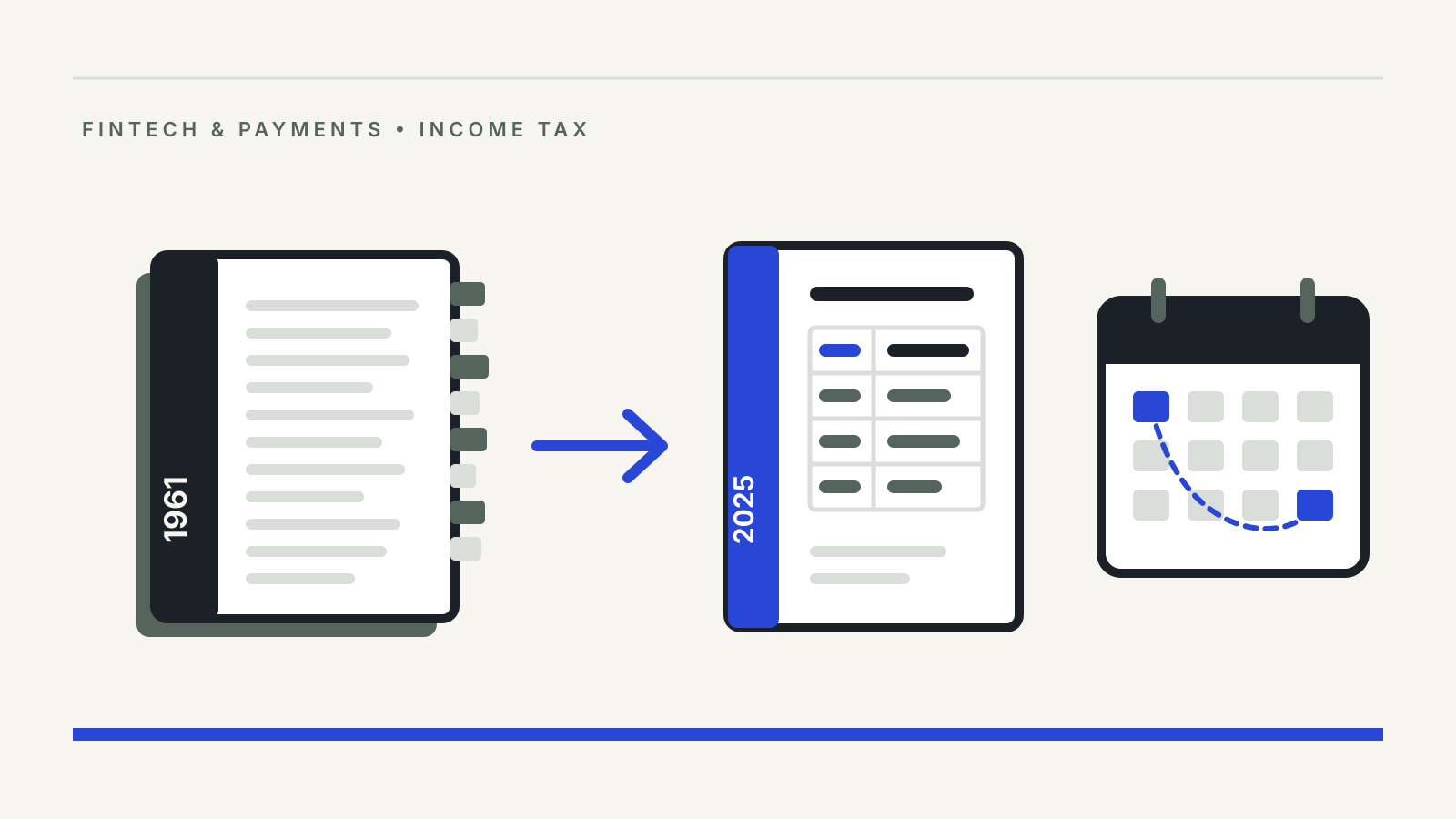
The Income-tax Act, 2025 changes the words, section numbers and form numbers an individual taxpayer works with, but not the tax itself. It replaced the Income-tax Act, 1961 on 1 April 2026, and the Income Tax Department says in its FAQs on the new Act that it “does not impose any new tax”. What does change is how you refer to a year, which sections your deductions sit under, and the names of the certificates your employer and bank give you.
The timing matters most this year. Income you earned up to 31 March 2026 is still taxed and assessed under the 1961 Act. Income from 1 April 2026 falls under the 2025 Act. Both laws will run side by side on the e-filing portal for a while.
A shorter law, the same policy
According to the department’s FAQ, the 2025 Act has 536 sections and 16 schedules, against 819 sections and 14 schedules in the 1961 Act. Provisos and explanations have been folded into the main text, and tables and formulas replace long narrative clauses. The rules have shrunk too: from 511 rules with 399 forms to 333 rules with 190 forms under the Income-tax Rules, 2026.
The government’s own explainer of 3 September 2025, published by the Press Information Bureau after Parliament passed the Income-tax (No. 2) Bill, 2025 in August 2025, lists the drafting principles: textual and structural simplification, “no major tax policy changes” and “no modifications of tax rates”. Tax slabs and rates for the year come from the Finance Act, as before; our income tax calculator for 2026-27 works through them for both regimes.
“Tax year” replaces “previous year” and “assessment year”
Under the old law, income earned in one financial year (the previous year) was assessed in the next (the assessment year). FY 2025-26 income, for example, belongs to AY 2026-27. Two labels for one set of income confused many people.
The 2025 Act uses a single term. A tax year is the twelve-month financial year starting on 1 April; it can be shorter only when a business or a new source of income starts during the year. Income earned from April 2026 to March 2027 is Tax Year 2026-27. There is no gap or overlap, as this table from the department’s FAQs on interplay and transition shows:
| Income earned | Governing law | Label | Return due (most individuals) |
|---|---|---|---|
| 1 April 2025 – 31 March 2026 | Income-tax Act, 1961 | AY 2026-27 | 31 July 2026 |
| 1 April 2026 – 31 March 2027 | Income-tax Act, 2025 | Tax Year 2026-27 | 31 July 2027 |
Source: CBDT, FAQs on Interplay and Transition from the Income-tax Act, 1961 to the Income-tax Act, 2025. Taxpayers needing an audit or a transfer pricing report have later dates (31 August, 31 October or 30 November).
So nobody files two returns in 2026. The return for FY 2025-26 income is filed under the old Act, with the old forms. The first return under the new Act is for Tax Year 2026-27 and falls due from July 2027.
Watch one detail when paying tax this year. The FAQ asks taxpayers to choose AY 2026-27 for any self-assessment tax on FY 2025-26 income, and Tax Year 2026-27 for advance tax on income earned from April 2026, so that the credit lands in the right year. Advance tax instalment dates are unchanged.
Your regime choice and deductions carry over
The new tax regime is in section 202 of the 2025 Act (section 115BAC in the old law), and it remains the default. If you had already opted for a regime under the old Act, the FAQ says that option is treated as made under the equivalent provision of the new Act; you do not have to opt again.
Deductions keep their substance but move to new places. The familiar section 80C becomes section 123, read with Schedule XV, which lists the eligible investments and payments. The ₹1.5 lakh aggregate limit is retained, and the qualifying items, such as life insurance premiums, provident fund contributions and tuition fees, are unchanged in substance. As before, section 123 is not available if you are in the new regime. The FAQ asks employees to quote the new section numbers in investment declarations for Tax Year 2026-27, and employers to update their payroll systems.
Losses already being carried forward under the old Act continue with the same conditions and time limits. A return of loss, for business losses for example, still has to be filed by the due date for the loss to be carried forward.
New section and form numbers you will see
Most changes an individual will notice are on paper. Under the 1961 Act, tax deducted at source (TDS) was spread across sections 192 to 194T. The 2025 Act gathers them into two: section 392 for salaries and section 393, set out in tables, for everything else, such as rent, interest, commission and crypto sales. Tax collected at source sits in section 394.
| Document | Old form (1961 Act) | New form (2025 Act) |
|---|---|---|
| TDS certificate for salary | Form 16 | Form No. 130 |
| TDS certificate for other payments | Form 16A | Form No. 131 |
| Declaration for no TDS on interest (below 60 / 60 and above) | Form 15G / Form 15H | Form No. 121 |
| Application for lower or nil TDS | Form 13 | Form No. 128 |
| Annual Information Statement | AIS | Form No. 168 |
Source: CBDT, FAQs on Interplay and Transition. Old forms continue for periods governed by the 1961 Act.
The changeover follows the date of payment. For salary paid in FY 2025-26 you still get Form 16, due by 15 June 2026. For salary in Tax Year 2026-27 you will get Form No. 130, due by 15 June 2027. Bank interest and other payments from April 2026 are covered by Form No. 131, and a senior citizen who wants the bank not to deduct tax on deposit interest for Tax Year 2026-27 now files Form No. 121 instead of Form 15H.
The AIS continues for years up to AY 2026-27; from Tax Year 2026-27 its role passes to Form No. 168. Credits for tax deducted in March 2026 will show against AY 2026-27, and those for tax deducted in April 2026 against Tax Year 2026-27.
Deadlines for late and updated returns
All return-filing rules now sit in one section. Under section 263 of the 2025 Act, a belated return can be filed within nine months from the end of the tax year, or before the assessment is completed, whichever is earlier. An updated return can be filed within 48 months from the end of the financial year after the tax year, and only once for a year.
For FY 2025-26 income the old rules still apply. The FAQ gives 31 December 2026 as the last date for a belated return for AY 2026-27, with a late fee of ₹1,000 where total income does not exceed ₹5 lakh and ₹5,000 otherwise. An updated return for that year is also filed under the old Act.
What stays the same
Your PAN, the TAN of your employer or bank, faceless assessment and faceless appeals all continue. Refunds you were entitled to under the old Act remain due, and assessments, notices and appeals for years before April 2026 are completed under the old law. Old circulars and notifications keep applying wherever they do not conflict with the new Act. Crypto income keeps its 30% rate and 1% TDS under new section numbers, as our crypto tax explainer sets out.
This article describes the law; it is not tax advice for your situation.
Questions
Does the Income-tax Act, 2025 change my tax rates?
No. The department says the new Act imposes no new tax. Slabs and rates for each year are set by the Finance Act, and the new regime remains the default.
Which Act applies to the return I file in July 2026?
The Income-tax Act, 1961. That return covers income earned up to 31 March 2026 and is filed for AY 2026-27 with the old forms.
What is section 80C called now?
Section 123 of the Income-tax Act, 2025, read with Schedule XV. The ₹1.5 lakh limit is retained, and the deduction is not available under the new regime.
Will I still get Form 16?
For FY 2025-26 salary, yes. For salary from April 2026, your employer issues Form No. 130 instead.
Sources
- Income Tax Department: Objective and scope of the new Act (FAQs)
- CBDT, Directorate of Income Tax (O&MS): FAQs on Interplay and Transition from the Income-tax Act, 1961 to the Income-tax Act, 2025
- Income Tax Department: Section 263, Income-tax Act, 2025
- Press Information Bureau: The Income Tax Act, 2025, 3 September 2025