A farmer asks about crop advice in Marathi. A state portal shows its forms in Odia. A bank wants its chatbot to answer in Tamil. Behind a growing number of such services in India sits Bhashini, the government’s language AI platform, which offers translation and speech services in Indian languages to government departments, startups and other developers.
This explainer covers what Bhashini is, what it offers, how developers get access and what limits apply.
What Bhashini is
Bhashini, short for BHASHa INterface for India, was launched by the Prime Minister on 4 July 2022 at Digital India Week in Gandhinagar. The launch release said it would enable access to the internet and digital services in Indian languages, including by voice, and that its key task would be building multilingual datasets, partly through a crowdsourcing initiative called BhashaDaan.
It is the platform of the National Language Translation Mission and is run by the Digital India BHASHINI Division, part of the Digital India Corporation under the Ministry of Electronics and Information Technology (MeitY). A PIB backgrounder of 9 February 2026 describes it as multilingual AI built as national digital public infrastructure, so that platforms can add language and voice features “without building them from scratch”.
What it offers
According to the platform’s API documentation, the models come from research groups at IITs, IIITs, C-DAC and other Indian institutes. The services exposed to developers include:
- speech recognition (speech to text);
- machine translation between languages;
- text to speech;
- transliteration between scripts;
- optical character recognition for scanned text;
- language detection for text and audio, and speaker diarisation, which separates who spoke when.
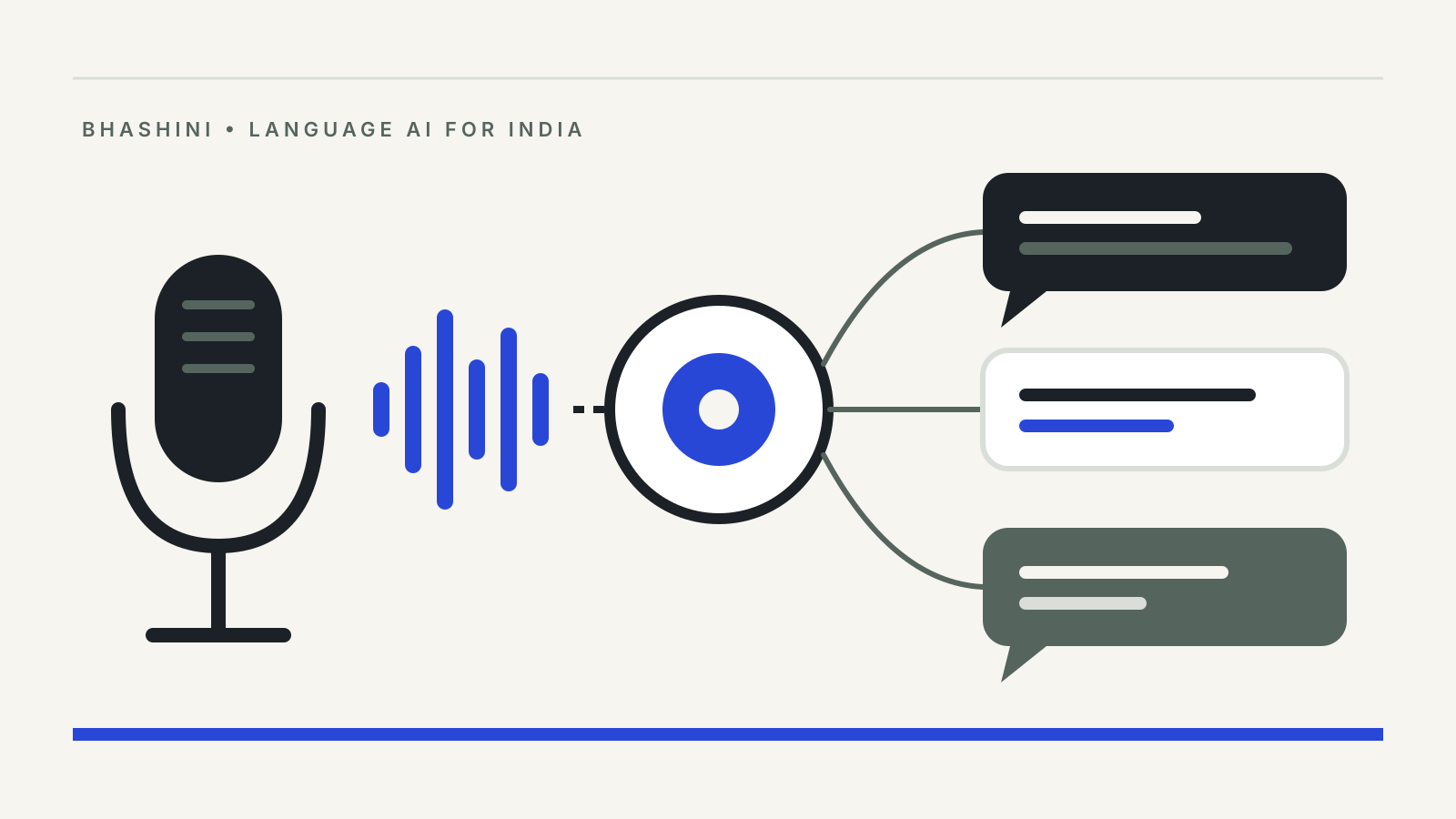
The services can be chained. A pipeline that runs speech recognition, then translation, then text to speech turns a spoken question in one language into a spoken answer in another.
On top of the APIs, the division runs its own applications. A PIB release of 10 April 2026 lists Anuvaad for text translation, Vaanianuvaad for speech translation, Lekhaanuvaad for documents, Chitraanuvaad for video, the Bhashini mobile app and a translation plugin for websites.
How big it has become
The division’s own figures have grown quickly through 2026. They are self-reported and not independently audited.
| PIB release | Languages | Scale reported |
|---|---|---|
| 9 February 2026 | Text in 36, voice in 22 | 350+ models and datasets; over 4 billion inferences in total |
| 12 March 2026 | 36 text, 23 voice, 35+ international | 500+ government websites; 15 million inferences a day; over 6 billion in total |
| 30 September 2026 | 36 Indian text, 23 Indian voice, 35 international | 800+ government websites; 24 million inferences a day; over 9 billion in total |
Sources: PIB releases of 9 February, 12 March and 30 September 2026. An inference is one request answered by a model.
Where the platform runs has also changed. A PIB release of 9 February 2026 said Bhashini had moved its datasets, models and APIs from a global hyperscaler to Indian cloud and GPU infrastructure, so that language data and citizen interactions stay within India’s jurisdiction.
Where it is being used
Recent tie-ups show the range. On 18 February 2026, at the India AI Impact Summit, the division launched VoicERA, an open-source voice AI stack for services such as agriculture advisories, grievance redressal and scheme discovery. On 23 February 2026 it signed an MoU with the Reserve Bank of India to deploy its models in the RBI’s ecosystem and co-develop “Banking BHASHINI”, a model trained on banking terms, across the 22 languages of the Eighth Schedule. And on 30 September 2026 the division and the Office of the Comptroller and Auditor General launched CAG-BHASHINI Anuvaad for translating official and audit documents, with human oversight kept in the process.
For the policy context, our explainers on the IndiaAI Mission and India’s AI governance guidelines set out the wider plan, and our piece on the RBI’s FREE-AI framework covers the rules banks are expected to follow when they use AI.
Who can use it, and how
Anyone can try the mobile app and the translation tools. Developers who want the APIs follow a separate route. The onboarding guide asks integrators to register on the Bhashini dashboard; a user ID and API keys become visible once the division’s team approves the account. Requests then go through two steps: a configuration call that picks a pipeline for the task, and a compute call that sends the text or audio.
The documentation sets a clear limit: free use of the APIs is “for the purposes of PoC only”. An organisation that wants to run them in production, or that charges its own users, is asked to contact the Bhashini team about paid plans. Participants in Bhashini hackathons request their API keys through a separate form.
What to check before you build on it
- Accuracy varies. Several models may exist for the same language and task, and the documentation notes that some pipelines suit particular domains, such as health or agriculture, better than others. Test with your own content before you rely on it.
- Personal data rules still apply. Sending customer names, phone numbers or account details through any translation or speech service is processing of personal data. The organisation remains responsible under the DPDP Act, as our guide to AI tools under the DPDP Act explains.
- Keep a human check where it matters. Translations of legal notices, loan terms or medical advice should be reviewed by a person fluent in the language, as the CAG launch itself provides.
- Plan for the production terms. A pilot built on free keys needs a paid arrangement before it goes live.
Sources
Press Information Bureau releases: launch of Digital India Bhashini, 4 July 2022; “Artificial Intelligence for Culture and Languages”, 9 February 2026; Bhashini’s move to Indian cloud infrastructure, 9 February 2026; VoicERA launch, 18 February 2026; MoU between the Digital India BHASHINI Division and the Reserve Bank of India, 24 February 2026; National Hub for Language Technologies, 12 March 2026; Pali language workshop, 10 April 2026; CAG-BHASHINI Anuvaad, 30 September 2026. Bhashini API documentation, overview and onboarding pages. Documents consulted on 16 October 2026.