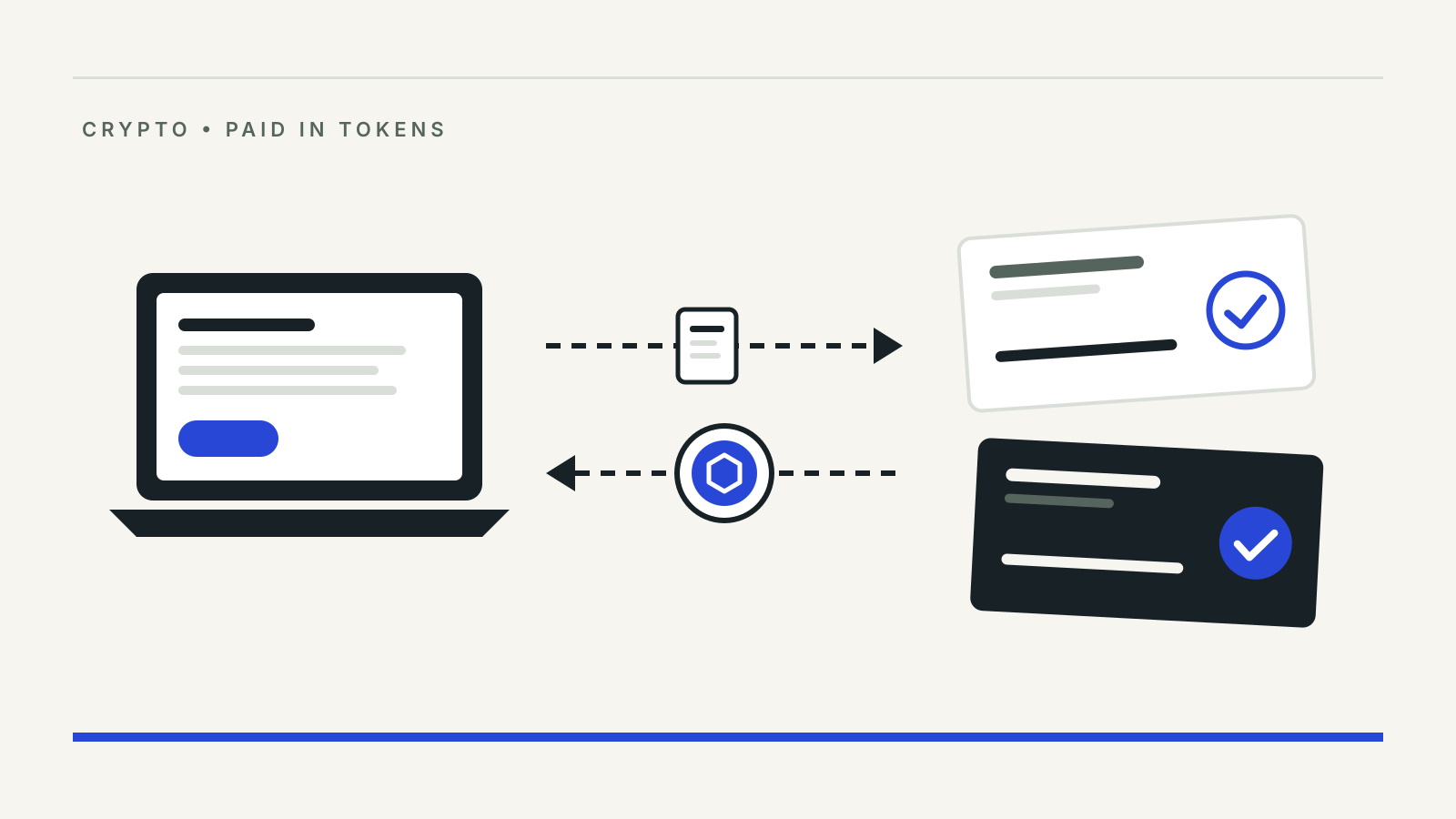
A designer in Pune finishes a project and the client offers to settle the bill in tokens instead of rupees. It sounds like a simple payment. For Indian tax purposes it is two transactions at once, and the Income Tax Department says both people in it may have a duty to deduct tax at source.
This guide covers crypto payment for services in India: who has to deduct TDS when work is paid for with a virtual digital asset (VDA), how the “payment in kind” rule works, and what changes when the tokens are later sold. It describes the law as the department publishes it; it is not advice on whether to accept or hold any asset.
Why a crypto fee counts as two deals
The 1% TDS on crypto does not depend on an exchange being involved. Under section 393(1) of the Income-tax Act, 2025, Table serial number 8(vi), any person paying a resident “any sum by way of consideration for transfer of a virtual digital asset” must deduct tax at 1%. In the Income-tax Act, 1961 the same rule is section 194S.
“Consideration” need not be money. When a client hands over tokens in return for your work, the client is transferring a VDA to you and your services are what you give in exchange for it. Seen from the other side, the client is paying you a fee for professional work, only in tokens rather than rupees.
The Income Tax Department’s explainer on TDS on VDA transfers uses exactly this case as its example. If an architect receives Bitcoin from a client as consideration for services, the explainer says, the architect “shall be liable to deduct tax under Section 194S as he is giving the consideration in the form of architecture services to the client transferring the VDA”, and the client “may also be liable to deduct tax under section 194J as he is making payment in form of VDA for services provided by the architect.”
The same page sets out the general rule behind that example: where a payer deducts tax under the VDA provision, “it shall not absolve the payee from deduction of tax under relevant provisions.” One withholding does not cancel the other.
The freelancer’s side: 1% on the tokens received
Because the freelancer is the one “paying” for the tokens, with services, the VDA rule can put the TDS duty on the freelancer. Two features of the law shape how that works.
There is no cash to deduct from. Note 6 to the Table in section 393(1) covers consideration that is “wholly in kind”, or partly in kind with too little cash to cover the tax. In that case the person responsible for paying “shall ensure that the tax required to be deducted has been paid, before releasing such consideration”. The department’s explainer adds a practical route from the CBDT: the seller of the tokens, here the client, can pay the tax as advance tax, and the deductor may rely on the seller’s declaration with a copy of the advance tax challan.
Small amounts are outside the rule. Section 393(4), Table serial number 12, switches off this deduction where the consideration in the tax year does not exceed ₹50,000 for an individual or Hindu undivided family with no business or professional income, or with turnover up to ₹1 crore in business or ₹50 lakh in a profession in the previous tax year. For everyone else the limit is ₹10,000. A working freelancer whose professional receipts crossed ₹50 lakh last year would therefore fall under the lower ₹10,000 limit.
The client’s side: TDS on the fee
The client’s duty comes from the ordinary rules for fees, not the crypto rules. In the 2025 Act these sit in the same section 393(1) Table, at serial number 6:
| Who pays the fee | Table entry | Rate in the Act | Threshold |
|---|---|---|---|
| A “specified person” paying fees for professional services | 6(iii) | 10% | ₹50,000 |
| A “specified person” paying fees for technical services (not professional) | 6(iii) | 2% | ₹50,000 |
| An individual or HUF not covered by 6(i) or 6(iii), paying professional fees or for contract work | 6(ii) | 2% | ₹50 lakh |
Source: section 393(1), Table serial number 6, Income-tax Act, 2025, Income Tax Department. The Act defines who is a “specified person” for each entry.
Section 393(4), Table serial number 9, adds an exemption: no tax is deducted on professional or technical fees that an individual or HUF pays “exclusively for personal purposes”. A family paying an architect for its own home is in a different position from a company paying a developer.
The “payment in kind” wording in Note 6 is written for the VDA and perquisite entries, not for professional fees, and the explainer’s architect example says only that the client “may also be liable”. How a client meets that duty when no rupees change hands therefore depends on the facts of each engagement, which is worth settling in writing before the work starts.
When the freelancer or client is outside India
The VDA rule in serial number 8(vi) applies to payments made to a resident. The department’s explainer notes that if the recipient is a non-resident, tax “may be deductible under Section 195” of the 1961 Act, the general withholding rule for payments to non-residents, which in the 2025 Act sits in section 393(2). An Indian freelancer paid in tokens by a foreign client has no Indian client to deduct the fee TDS, but still has to account for the income in their own return.
Selling the tokens later
Receiving tokens as a fee and selling them are separate events. When the freelancer later sells, swaps or spends the tokens, that transfer falls under the VDA regime: a flat 30% rate, no deduction except the cost of acquisition, no set-off of losses, and 1% TDS by the buyer or exchange. Our guide to crypto tax in India explains those rules, and Schedule VDA in the ITR shows where each transfer is reported. If the tokens arrive as a gift rather than a fee, a different charge applies, covered in our guide to crypto gift tax in India.
Two records make all of this easier: the invoice showing the agreed fee in rupees, and the value of the tokens on the day they were received. The rupee value is what TDS thresholds, rates and the later cost of acquisition are measured against.
Questions
Who deducts TDS when a client pays a freelancer in crypto?
Possibly both. The department’s explainer says the person receiving the tokens may have to deduct 1% under the VDA rule, because they give services in exchange, and the client may have to deduct TDS on the professional fee.
Does the 1% VDA TDS apply if the tokens are worth ₹20,000?
Not always. For an individual or HUF payer with no business income, or with turnover within the limits in section 393(4), no deduction is needed until the year’s VDA consideration exceeds ₹50,000. For other payers the limit is ₹10,000.
How is TDS paid when there is no cash in the deal?
Under Note 6 to the Table in section 393(1), the person responsible must ensure the tax has been paid before releasing the consideration. The CBDT allows the other party to pay it as advance tax and give a declaration with the challan.
Which law applies to my 2026 return?
Payments made from tax year 2026-27 are governed by the Income-tax Act, 2025. Our guide to the Income-tax Act, 2025 changes explains how the old section numbers map to the new Act.