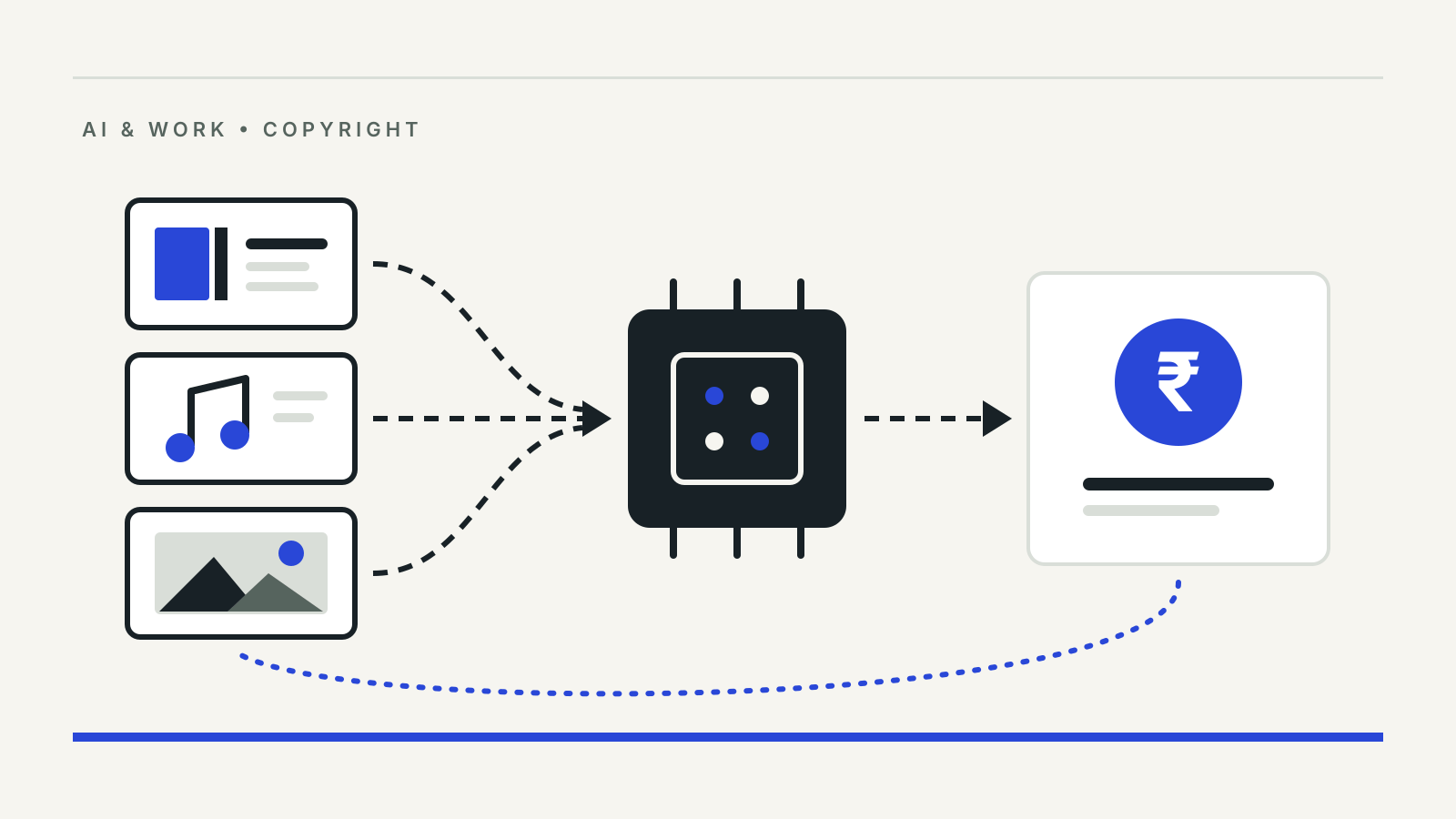
AI copyright in India still runs on the Copyright Act, 1957, which has no rule for training AI models on other people’s work. The government’s answer so far is a proposal. In December 2025 the Department for Promotion of Industry and Internal Trade (DPIIT) published Part 1 of a working paper, “One Nation One License One Payment”, that would let AI developers train on all lawfully accessed work without permission and pay creators a share of revenue.
This guide reads that paper: what it proposes, how the royalty would be collected and shared, where industry disagreed, and what it means for writers, artists and companies using AI tools at work.
Why DPIIT took up the question
DPIIT set up an eight-member committee on 28 April 2025 to check whether the existing law can handle generative AI and to recommend amendments if needed. The committee split its work in two. Part 1 deals with inputs: using copyrighted works as training data. Part 2 was to deal with outputs: whether AI-generated works can be copyrighted, who the author is, whether moral rights apply and who is liable when an output infringes.
The working paper notes that the current law offers only a narrow defence. Fair dealing under section 52(1)(a) covers limited purposes such as private or personal use including research, criticism or review, and reporting of current events. Whether training an AI model fits that, and whether training infringes at all, is being argued before the Delhi High Court in ANI Media Pvt. Ltd. v. OpenAI Inc., which the paper describes as India’s first major AI and copyright case and which it records as pending. The committee said waiting for courts here and abroad to settle the issue “may not be optimal”.
The options the committee rejected
The paper weighs five models and finds problems with each in its traditional form:
- Voluntary licensing, where each developer negotiates with rights holders. The content industry backed this unanimously, but the committee saw long negotiations and high transaction costs that would hurt startups and small firms.
- A blanket text and data mining (TDM) exception, which most of the tech industry wanted. The committee called it not “a prudent policy approach”, because it would leave human creators unable to seek compensation.
- A TDM exception with an opt-out, the route taken in the European Union. The paper argues small creators would not know to opt out or be able to check whether their work was scraped, and that opt-outs do not work without heavy transparency duties on developers.
- Collective and extended collective licensing, and statutory licensing, which it found hard to fit to the scale and opacity of AI training.
PIB’s release summarised the conclusion as rejecting a “zero price license model” because it would weaken incentives for human creativity.
The hybrid model: licence first, pay later
What the majority recommends is a mandatory blanket licence in favour of AI developers, paired with a statutory right to remuneration for copyright holders. In practice:
- No permission needed. All lawfully accessed copyrighted content would be available for training “as a matter of right”, without individual negotiations. Rights holders could not withhold their works.
- No upfront fee. Royalties become payable only when the AI system is commercialised. The paper suggests a flat percentage of the developer’s gross global revenue (excluding taxes) from that AI system, paid annually.
- Rates set by government. A Rate Setting Committee formed by the Central Government, with officials, legal, financial and technical experts plus a member from the collecting body and a representative of AI developers, would fix the rate and review it every three years. Its rates could be challenged in court.
- No small-firm threshold. MeitY had suggested a minimum revenue below which no royalty is due. The majority declined, reasoning that a revenue share already means a small startup pays little.
- Retroactive effect. Developers who have already trained models on copyrighted content and are earning from them would also owe royalties under the rates set.
Who would collect and share the money
The paper proposes a single non-profit body, the Copyright Royalties Collective for AI Training (CRCAT), formed by associations of rights holders and designated by the Central Government under the Copyright Act. Its members would be copyright societies and collective management organisations, one per class of work. Sectors without such a body would be represented on its board by government nominees.
Each AI developer would file an “AI Training Data Disclosure Form” with a summary of the data used: the class of work (text, images, music and so on), the source (social media, publications, online libraries, public or proprietary datasets) and the nature of the data (news, literature, entertainment). The paper calls this a “light touch” format. CRCAT would split each developer’s payment among classes of work in proportion to that disclosure.
Creators would be paid only if they register. Each member organisation would run a “Works Database for AI training royalties” open to members and non-members alike, asking for basic details such as author, title, where the work is hosted and the date of creation or publication. How the money is then shared, equally per work or weighted by value, is left to each organisation’s distribution policy. Royalties for sectors with no collecting society would be held for three years and then moved to a welfare fund for those sectors.
Two further points matter for companies. Royalties for a model fine-tuned on a specific domain, say news, would flow only to registrants in that domain and would be separate from those owed for the base model. And if a developer claims it used only proprietary data, the burden of proving that would fall on the developer.
The dissent
Nasscom, a committee member, disagreed in written submissions dated 17 August 2025, which the paper reproduces. It recommended a TDM exception for commercial and non-commercial use where access is lawful, with rights holders able to reserve publicly available content through a machine-readable opt-out and other content through contract or licence terms.
What it means for you now
The working paper is a consultation document. DPIIT opened it for 30 days of public comment when it was released on 9 December 2025. The model needs changes to the Copyright Act, 1957 and rules under it before any licence, royalty or collecting body exists, so nothing in it binds developers or creators today.
- Writers, musicians, photographers and publishers: keep records of what you publish and when. If the model becomes law, payment depends on registering works, with publication dates used to decide which models a work could have trained.
- Companies using AI tools at work: the paper places the royalty on the developer who commercialises the model, or on whoever buys or licenses the model or training data, and expects licence agreements to say who pays. Check how your AI vendor contracts allocate that risk. Separate obligations apply to personal data; see our guide to using AI tools under the DPDP Act.
- AI developers in India: the disclosure form and revenue-based royalty are the parts to watch, along with the court ruling in the ANI case.
For the wider policy picture, read our explainer on India’s AI governance guidelines.
Questions
Is it legal to train AI on copyrighted content in India?
The Copyright Act, 1957 has no specific exception for AI training, and the fair dealing provision in section 52(1)(a) is narrow. Whether training infringes is pending before the Delhi High Court. DPIIT’s proposal would settle it by statute, but it has not been enacted.
Would creators be able to opt out of AI training under DPIIT’s proposal?
No. Under the hybrid model rights holders could not withhold lawfully accessed works from training. They would instead receive royalties, if they register their works.
How much would AI developers pay?
The paper does not fix a number. It proposes a percentage of gross global revenue from the commercialised AI system, set by a government-appointed committee and reviewed every three years.
Does the proposal cover who owns AI-generated content?
No. Copyright in AI outputs, authorship, moral rights and liability for infringing outputs were left to Part 2 of the working paper.