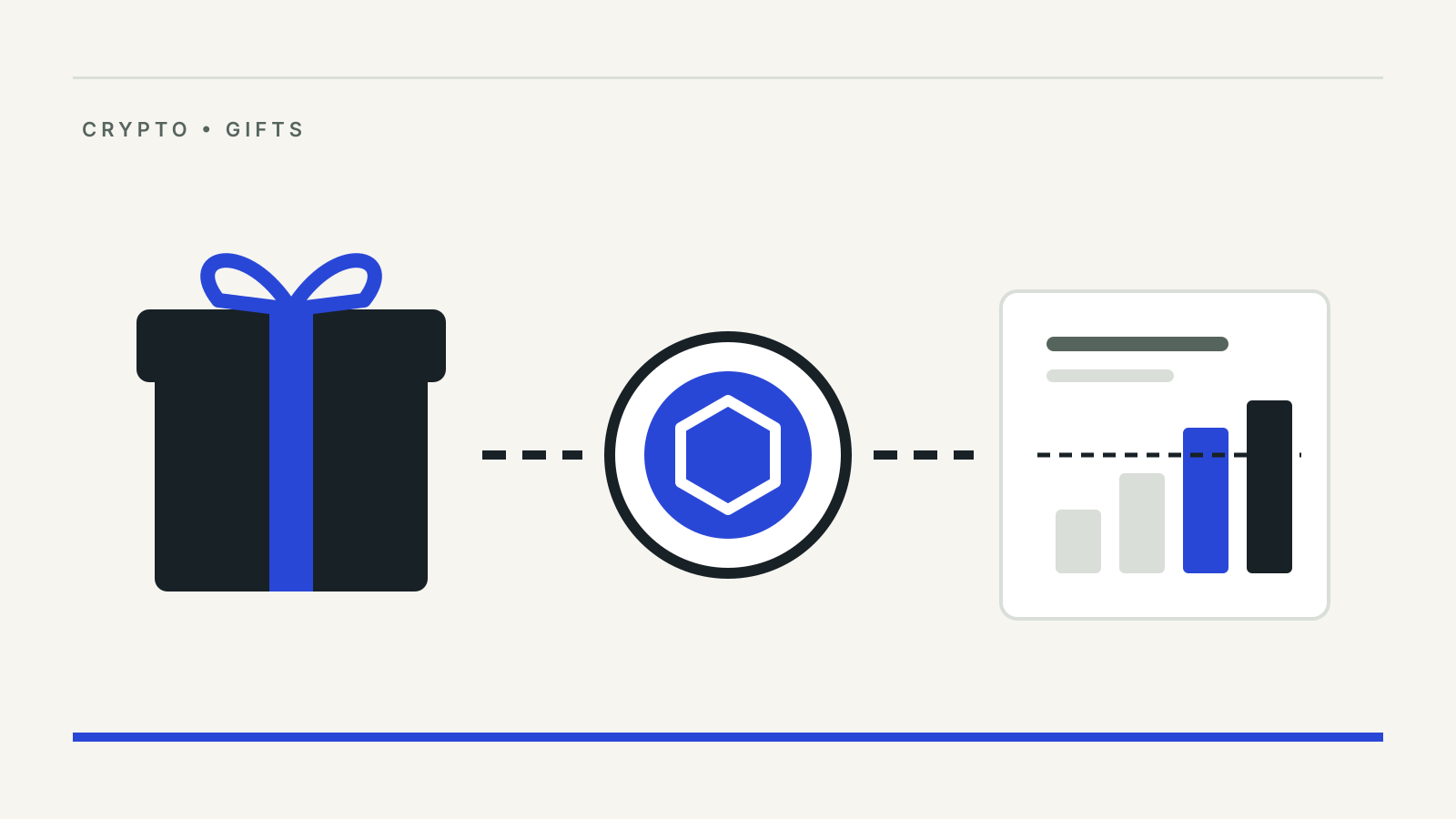
Crypto gift tax in India turns on one question: who gave you the tokens. A gift of cryptocurrency or another virtual digital asset (VDA) from a friend, an online contact or a business is taxed in your hands once the total value of such gifts in the tax year crosses ₹50,000. The same gift from a parent, a spouse or another relative named in the law is not taxed when you receive it.
That rule has applied since the Finance Act, 2022 added VDAs to the property covered by the Income-tax Act’s gift provisions, and it carries over into the Income-tax Act, 2025, which governs tax year 2026-27 onwards. This guide deals with the person who receives the gift. The 30% tax and 1% TDS that apply when you later sell are covered in our guide to crypto tax in India.
How crypto gifts came into the tax net
Before 2022, the gift provisions taxed only certain kinds of movable property: shares and securities, jewellery, archaeological collections, drawings, paintings, sculptures, works of art and bullion. A token received for nothing sat outside that list.
The Memorandum explaining the Finance Bill, 2022 set out the change in one paragraph. “In order to provide for taxing the gifting of virtual digital assets”, the Bill amended the Explanation to section 56(2)(x) of the 1961 Act so that “property” would “include virtual digital asset”. The amendment applied from assessment year 2023-24.
In the 2025 Act the charge sits in section 92(2)(m). Section 92(5)(f) defines “property” as a closed list of ten capital assets, and the last item on it is “virtual digital asset”.
When a crypto gift is taxable
Under section 92(2)(m)(iii)(A), when anyone receives property other than land or buildings without consideration, and “the aggregate fair market value of which exceeds ₹50000”, the whole of that aggregate value is charged to tax under the head “Income from other sources”.
Four points in that clause decide most cases:
- The ₹50,000 test is aggregate. It adds up the fair market value of all listed property received as gifts in the tax year, so tokens are counted together with any gifted shares or jewellery. Gifts of money are tested separately under section 92(2)(m)(i).
- It is a threshold, not an allowance. The Income Tax Department’s guide to the tax treatment of gifts, written for the 2025 Act as amended by the Finance Act, 2026, says that once the total crosses ₹50,000, the entire value is taxed, not only the part above the limit.
- Value means fair market value. The definitions in section 92(5) say the fair market value of property other than land or buildings is “the value determined by such method as may be prescribed”, so the valuation follows the Income-tax Rules rather than a figure the giver chooses.
- Cheap sales count too. Section 92(2)(m)(iii)(B) also covers property received for a consideration that is lower than its fair market value by more than ₹50,000. In that case the difference between the fair market value and the price paid is taxed.
Take an illustration. In one tax year a friend transfers you tokens worth ₹30,000 on the day of transfer, and a former colleague later sends tokens worth ₹25,000. Each gift is below ₹50,000, but together they come to ₹55,000, so the full ₹55,000 is income in your hands. Had the second gift been worth ₹15,000, the total of ₹45,000 would not be taxed at all.
Gifts that are not taxed
Section 92(3) switches off the gift charge for money or property received in several situations. The ones most relevant to a personal crypto gift are gifts:
- from a relative;
- on the occasion of your marriage;
- under a will or by inheritance;
- in contemplation of the death of the giver.
“Relative” has a fixed meaning in section 92(5)(g). For an individual it covers a spouse; brothers and sisters; brothers and sisters of the spouse; brothers and sisters of either parent; any lineal ascendant or descendant, maternal and paternal; the same for the spouse; and the spouses of all those people except your own spouse. For a Hindu undivided family it means any member.
Friends are not on the list, and nor are cousins, since a cousin is neither a sibling nor a lineal relative. The department’s gift guide adds a point about occasions: marriage is the only occasion on which gifts from non-relatives escape the charge. Tokens received on a birthday, an anniversary or a festival are taxable once the aggregate test is met.
| Who sent the tokens | Taxed on receipt? |
|---|---|
| Parent, grandparent, child, spouse, sibling | No: relatives under section 92(5)(g) |
| Spouse’s parent or sibling | No: relatives under section 92(5)(g) |
| Friend, cousin, colleague, online contact | Yes, if the year’s aggregate fair market value of gifted property exceeds ₹50,000 |
| Anyone, on the occasion of your marriage | No |
| Under a will or by inheritance | No |
Source: section 92(2)(m), 92(3) and 92(5) of the Income-tax Act, 2025, Income Tax Department.
Does the giver deduct 1% TDS?
The 1% TDS on crypto is attached to payment. Section 393(1) of the 2025 Act, Table entry 8(vi), requires a person paying “any sum by way of consideration for transfer of a virtual digital asset” to a resident to deduct tax. The department’s explainer on TDS on VDA transfers describes buyers, exchanges and brokers as the people who deduct, and adds a rule for swaps paid in kind, where the payer must ensure the tax has been paid before releasing the consideration.
A pure gift involves no payment and no consideration, so the TDS provision, as written, has nothing to bite on. The tax on a taxable gift is instead paid by the recipient, as part of their income for the year, when they file their return.
Selling gifted crypto later
Receiving the gift and selling the tokens are two separate events. If you later sell, swap or spend gifted tokens, the income from that transfer falls under the VDA scheme: a flat 30% rate, no deduction other than the cost of acquisition, and no set-off of losses. The person paying you for them may also have to deduct 1% TDS. Our guide to Schedule VDA in the ITR shows where each transfer is reported.
Two practical habits follow from the law. Keep a record of the date each gift arrived and its value on that day, because the gift charge is based on fair market value at receipt. And if the tokens came from a relative, keep evidence of the relationship and the transfer, since the exemption depends on who the giver was.
This is a description of the law, not advice on whether to give, accept or sell any asset.
Questions
Is crypto received from parents taxable in India?
No, not on receipt. Parents are lineal ascendants and therefore relatives under section 92(5)(g), and section 92(3) excludes gifts from relatives from the gift charge. Tax arises later if you sell or swap the tokens.
Is a crypto gift from a friend taxable?
Yes, if the total fair market value of gifted property you receive from non-relatives in the tax year exceeds ₹50,000. Below that, nothing is taxed.
Is only the amount above ₹50,000 taxed?
No. Once the aggregate crosses ₹50,000, the whole value is income from other sources.
Does the person gifting crypto have to deduct TDS?
The TDS provision applies to a sum paid as consideration for a transfer. A gift with no consideration involves no such payment; the recipient accounts for a taxable gift in their own return.
Sources
- Income Tax Department: Section 92, Income-tax Act, 2025 (income from other sources, gifts, definitions of property and relative)
- Income Tax Department: Tax treatment of gifts received by an individual or HUF (Income-tax Act, 2025 as amended by the Finance Act, 2026)
- Income Tax Department: Section 393, Income-tax Act, 2025
- Income Tax Department: TDS on payment for the transfer of virtual digital assets
- Ministry of Finance: Memorandum explaining the provisions in the Finance Bill, 2022