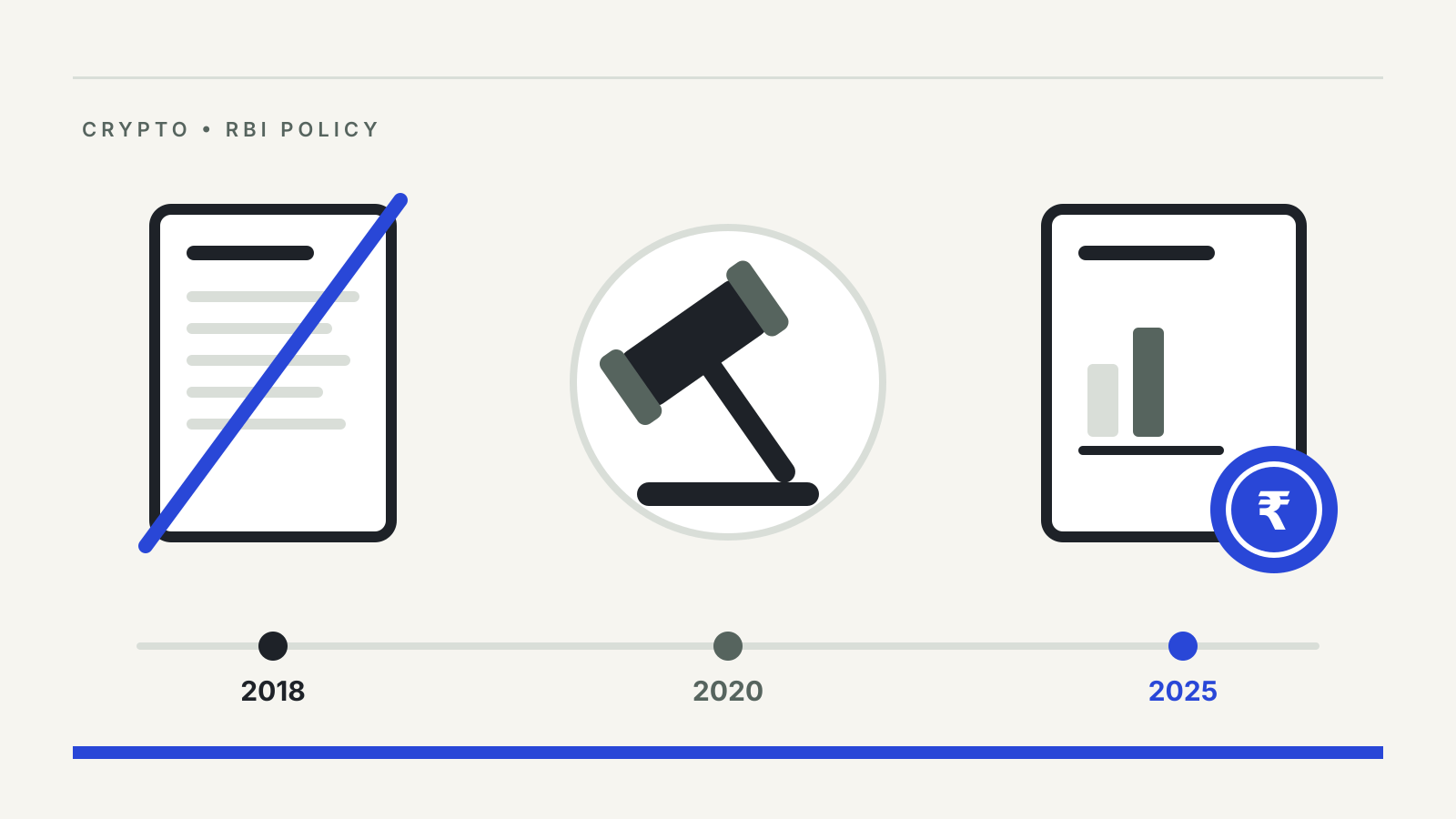
The RBI on cryptocurrency has been consistent for more than a decade: it warns against private crypto assets, it does not regulate the exchanges that trade them, and it wants a central bank digital currency, not private tokens, to be the future of digital money in India. What has changed is the tool it uses. A banking ban in 2018 was struck down by the Supreme Court; today the Reserve Bank of India makes its case through warnings, its Financial Stability Reports and the digital rupee.
For an Indian investor that history explains three things you will run into: why your bank may still ask questions about transfers to an exchange, why no RBI rule protects your crypto holdings, and why the central bank keeps talking up the e₹.
From public warnings to a banking ban
The RBI’s first step was a series of cautions. Its circular of 6 April 2018, “Prohibition on dealing in Virtual Currencies (VCs)”, records that the bank had warned “users, holders and traders of virtual currencies, including Bitcoins” in public notices on 24 December 2013, 1 February 2017 and 5 December 2017.
The April 2018 circular then went much further. It told banks, NBFCs and payment system providers that, with immediate effect, they “shall not deal in VCs or provide services for facilitating any person or entity in dealing with or settling VCs”. The services it named included maintaining accounts, trading, settling, giving loans against virtual tokens, opening accounts of exchanges and moving money for crypto purchases or sales. Entities already providing such services were given three months to exit.
The Supreme Court and the 2021 clarification
That circular no longer stands. In a circular of 31 May 2021, “Customer Due Diligence for transactions in Virtual Currencies (VC)”, the RBI said the 2018 circular “was set aside by the Hon’ble Supreme Court on March 04, 2020” in Internet and Mobile Association of India v. Reserve Bank of India (Writ Petition (Civil) No. 528 of 2018). It told banks that the circular “is no longer valid” from the date of the judgment and “cannot be cited or quoted from”.
The 2021 circular was written because, as it says, some banks had been warning customers off crypto by quoting the dead circular. It did not tell banks to open their doors without questions. They may “continue to carry out customer due diligence processes” under the KYC, anti-money laundering and counter-terror financing rules and the Prevention of Money Laundering Act, 2002, and must comply with the Foreign Exchange Management Act for overseas remittances.
That is the position your bank works under today. It cannot point to the 2018 circular to turn you away, but it may apply its normal due diligence checks to your crypto-related transfers. The wider legal picture, including the court ruling and the PMLA registration of exchanges, is in our explainer on whether crypto is legal in India.
What the RBI says now: the Financial Stability Report
The clearest recent statement is a special feature in the RBI’s Financial Stability Report, December 2025, titled “Financial Stability Implications of Stablecoins”. Its conclusion is blunt: “Currently, risks from stablecoins to macrofinancial stability outweigh their purported benefits.”
The report sets out why the RBI cares about this in India specifically:
- Monetary sovereignty. Easy access to dollar-linked tokens could lead to what the report calls “digital dollarisation”, weakening the transmission of domestic monetary policy.
- Capital controls. Stablecoins, “like other crypto assets, can be used to bypass the current system for transferring foreign exchange in and out of the country”, which matters for an economy like India where capital flow management plays “a key role in preserving external sector stability”.
- Bank deposits. Yield-bearing products built on stablecoins could compete with bank deposits and make deposit flows more volatile in stress.
- Financial crime. The report says that since 2022 stablecoins have replaced bitcoin as the main vehicle for illicit crypto flows.
It then states the RBI’s own stance in its own words: the RBI “maintains a cautious stance on crypto assets, including stablecoins, prioritising sovereign digital infrastructure to safeguard monetary sovereignty”. And it ends with a policy preference: the RBI “strongly advocates that countries should prioritise central bank digital currencies (CBDCs) over privately issued stablecoins”.
The Financial Stability Report of June 2026 kept the subject on the watch list. Its chapter on regulatory initiatives notes that stablecoins “continued to garner close regulatory attention” because of their growing links with traditional markets and payment systems, and that the December 2025 report had flagged issuers becoming significant holders of traditional reserve assets, “a trend that continues to warrant close monitoring”.
The CBDC answer
The RBI’s alternative is the digital rupee. In the December 2025 report it argues that CBDCs “can achieve the benefits that stablecoins claim to offer, i.e., efficiency, programmability, and instant settlement, but with the credibility and safety of central bank money”. How the retail e₹ works, which banks offer wallets and how it differs from UPI is covered in our guide to the digital rupee.
What the RBI does not do
The RBI’s statements are warnings and analysis, not a licensing regime for crypto, and none of the documents above sets up RBI registration for exchanges. Exchanges serving Indian users have to register with the Financial Intelligence Unit under the PMLA, which you can check using our guide to FIU-registered crypto exchanges in India. Tax is set by Parliament, not the RBI; the rules are in our crypto tax explainer.
The RBI Ombudsman handles complaints against banks, NBFCs and other entities covered by its scheme, as our RBI Ombudsman complaint guide lists; a crypto exchange is not on that list. Fraud should be reported on 1930, as our guide to crypto scams in India explains.
This article explains the RBI’s published positions; it is not advice to buy or sell any crypto asset.