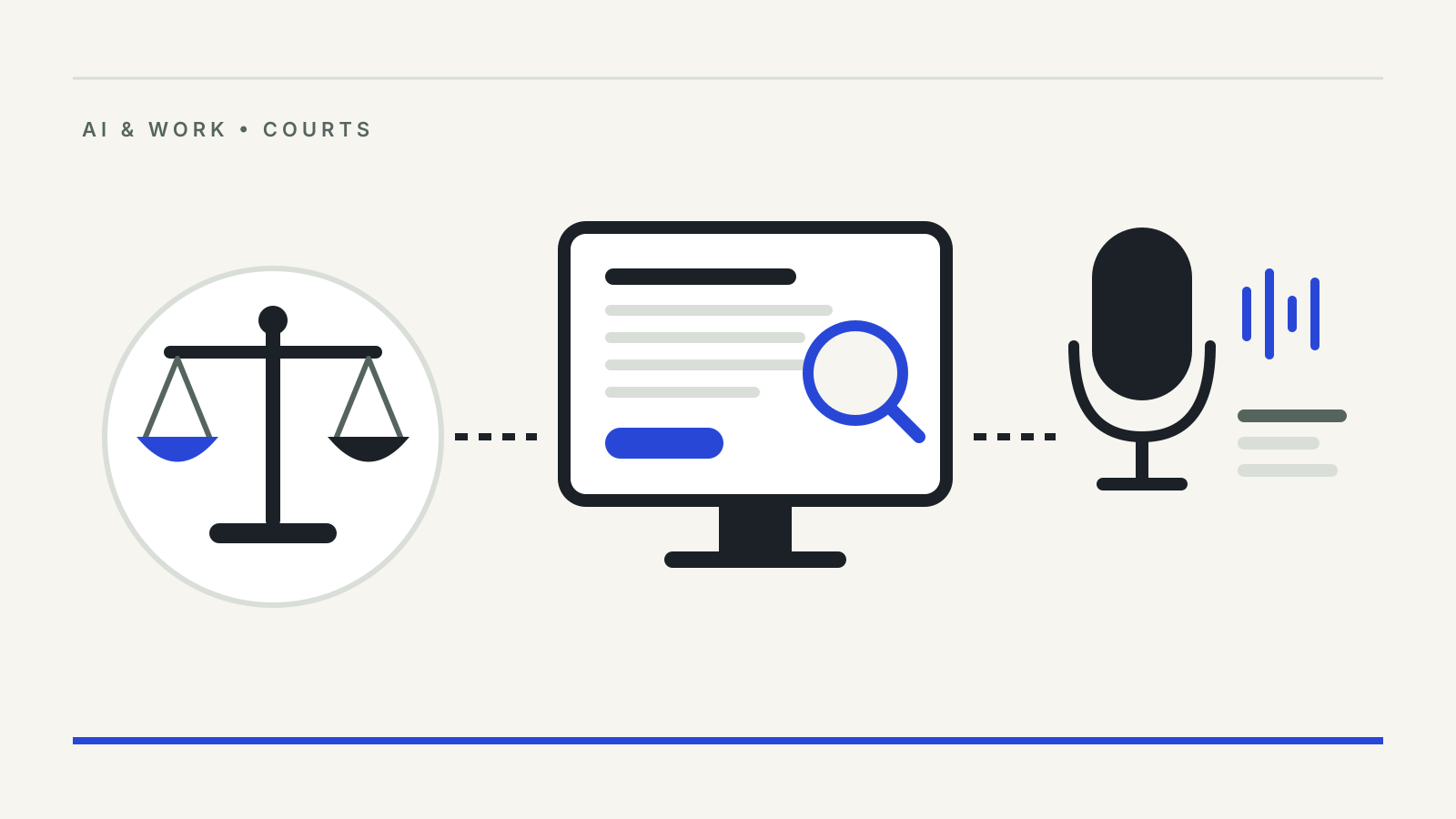
AI in Indian courts is still a pilot, not a practice. Two tools built for judges, one for legal research and one for dictation and translation, were being tested in mid-2026, and the government has told Parliament that their use stays within controlled pilots. There is no single national rulebook: the Union government says the operating rules are for the Supreme Court and each High Court to set.
This explainer draws on three written answers by the Ministry of Law and Justice to the Lok Sabha, from December 2025 to July 2026, and sets out what is being tested, where the money comes from and which safeguards have been described.
Where the money comes from
AI work in the courts sits inside Phase III of the eCourts Mission Mode Project, run by the Department of Justice with the eCommittee of the Supreme Court. The answer of 5 December 2025 puts the phase’s outlay at ₹7,210 crore, of which ₹53.57 crore is earmarked for a component called “Future Technological Advancements (AI, Blockchain etc)”.
The Supreme Court has constituted an AI Committee. According to the answer of 13 March 2026, it is responsible for conceptualising, implementing and monitoring the use of AI in the Indian judiciary.
The tools being tested
| Tool | Built by | What it does | Status |
|---|---|---|---|
| Legal Research Analysis Assistant (LegRAA) | AI Division of NIC and the Centre of Excellence for eCourts (CoEE), NIC | Helps judges with legal research and document analysis | Pilot testing (July 2026) |
| Digital Courts 2.1 | CoEE, NIC, Pune | Paperless case management in one window, with voice-to-text (ASR-SHRUTI) and translation (PANINI) for dictating orders and judgments | Pilot testing (July 2026) |
| AI and machine-learning prototypes | Supreme Court with IIT Madras | Curing defects in filed documents, extracting metadata, linking e-filing with the court’s case management system (ICMIS) | Prototypes under test (March 2026) |
Sources: Lok Sabha unstarred questions 3484 (13 March 2026) and 2104 (31 July 2026), Ministry of Law and Justice.
The answer of 31 July 2026 confirms that both LegRAA and Digital Courts 2.1 were in the pilot testing phase. The tasks the government lists are research, document analysis, transcription and translation. None of the three answers describes an AI tool that decides a case or drafts findings on its own.
What the safeguards look like
Court data, not outside data. The March 2026 answer says LegRAA and Digital Courts 2.1 address data privacy and ethical safeguards by using the courts’ own data: judgments and orders of the Supreme Court, High Courts and district courts.
A judges’ sub-committee on security. The Chairperson of the eCommittee has formed a sub-committee of six High Court judges, with technical experts, to recommend secure connectivity and authentication for data and privacy protection and to assess the eCourts infrastructure.
Known risks, named. The December 2025 answer lists the challenges the judiciary is aware of: algorithmic bias, language and translation issues, data privacy and security, and “the need for manual verification of AI-generated outputs”. It adds that the eCommittee had reported no systemic bias, unintended content or other issues during the pilot phase.
Approved areas only. The same answer says AI is used only within the areas approved in the detailed project report for eCourts Phase III.
Who writes the rules
In December 2025 the ministry said plainly that “no formal policy or guidelines exist for adopting AI tools in judicial processes”, because AI solutions were still in a controlled pilot phase. By March and July 2026 its answers had settled on a division of labour: the operational framework for using AI is decided under the rules of business and the policies of the Supreme Court and the respective High Courts.
The July 2026 question asked directly whether the government was considering a national policy to separate approved from unapproved AI tools and to prohibit AI in judicial findings, orders and judgments. The answer did not announce one. In practice, any restriction on what a judge, clerk or court staff member may do with an AI tool will come from the judiciary itself, court by court.
For anyone checking what an AI system tells them about a case or a law, the general method in our guide to checking an AI answer against its sources applies just as much to legal research.
Deepfakes as evidence
The other side of AI in courts is fabricated material reaching them. The December 2025 answer says such cases are filed under the Information Technology Act, 2000, including identity theft (section 66C), cheating by personation using a computer resource (section 66D) and obscene material (sections 67, 67A and 67B), and under the Bharatiya Nyaya Sanhita, 2023, including cheating by personation (section 319) and forgery of electronic records (sections 336 and 340).
Authentication has also tightened. Section 63 of the Bharatiya Sakshya Adhiniyam, 2023 requires a certificate to establish the authenticity of an electronic record offered as evidence. The answer also points to live-streaming of many proceedings and the Judgment Search Portal as ways of keeping authentic records public. How platforms must label synthetic media is covered in our explainer on deepfake labelling under the IT Rules, and how cloned voices are used in fraud is in our guide to the AI voice cloning scam in India.
What to watch
The pilots, the AI Committee’s work and any High Court policies are where change will show first. The wider government approach to AI risk is set out in our explainer on India’s AI governance guidelines.
Sources
Ministry of Law and Justice (Department of Justice), Lok Sabha Unstarred Question No. 1006, “Use of AI based Digital Content in Judiciary”, answered 5 December 2025; No. 3484, “Use of Artificial Intelligence in Judiciary and Safeguards”, answered 13 March 2026; No. 2104, “Use of AI in Indian Judiciary”, answered 31 July 2026. Documents consulted on 20 October 2026.