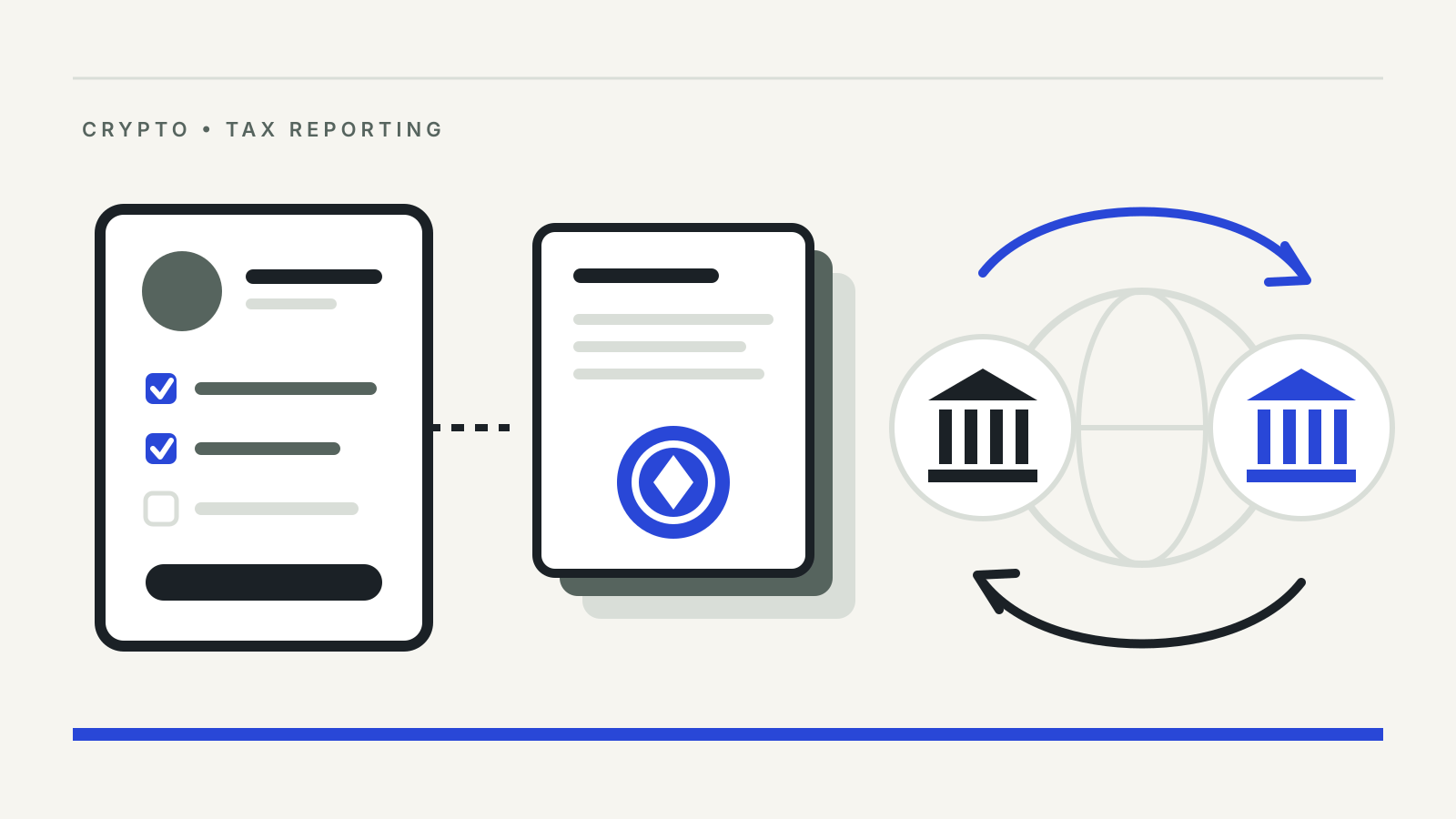
Since 1 January 2026, crypto exchanges operating in India have had to ask every customer a question that goes beyond KYC: in which countries are you resident for tax? The question comes from the crypto asset reporting framework, or CARF, which India has written into its income-tax law. It is the start of a system under which crypto platforms report their customers’ transactions to tax authorities, who then swap that information across borders.
This explainer covers what the Indian rules require, who has to report, what gets reported and what it means for an ordinary investor in India.
Where the rules come from
The Finance Act, 2025 inserted a new section 285BAA into the Income-tax Act, 1961, from 1 April 2026, requiring a prescribed “reporting entity” to furnish information on crypto-asset transactions. The Income-tax Act, 2025, which replaced the 1961 Act on the same date, carries the same duty as section 509. The section leaves the detail to rules: who must register, what they must keep and what due diligence they must do on users.
That detail sits in rules 241 to 244 of the Income-tax Rules, 2026, uploaded by the Income Tax Department on 8 January 2026, and in Form 167. The rules follow the CARF model developed by the OECD at the G20’s request. On 24 July 2026 the CBDT’s Foreign Tax and Tax Research Division released a Guidance Note on Crypto-Asset Reporting Obligations, with FAQs, to explain them to service providers.
A separate change brought crypto into the older bank-account reporting system. CBDT Notification 19/2026 of 5 March 2026 amended rule 114F of the 1961 Rules, from 1 January 2026, so that “financial asset” under the Common Reporting Standard includes an interest in a relevant crypto-asset, including futures and options, and added central bank digital currencies to the definitions.
Who has to report
The duty falls on a “reporting crypto-asset service provider”. Rule 241 defines it as any individual or entity that, as a business, effects exchange transactions for customers: swapping crypto for rupees or other currencies, or one crypto-asset for another. That includes acting as a counterparty or intermediary, or running a trading platform. The rule lists dealers, crypto ATM operators, exchanges that make markets, and brokers.
Under rule 242, a provider reports in India if it is resident in India for tax, is incorporated or managed here, has legal personality or a return-filing duty here, or has a regular place of business in India. Transactions through an Indian branch are covered. A provider with links to several countries follows a ranking so that it reports once, in the country with the strongest connection.
Not every token is in scope. The rules exclude central bank digital currencies, which keeps the digital rupee out, and “specified electronic money products”: tokens representing a single fiat currency that the issuer must redeem at par on demand under regulation. A token the provider has determined cannot be used for payment or investment is also out.
Whose data is reported
This is the point most often misunderstood. Under rule 241, a “reportable person” is an individual or entity resident for tax in a country or territory outside India. An Indian exchange therefore reports to the Indian tax department on its foreign-resident customers, so that the information can be passed to their home countries. Information about Indian residents is meant to flow the other way: from exchanges abroad, through their tax authorities, to India.
To sort customers, rule 244 requires a self-certification from every user. For an individual it must give:
- first and last name
- residence address
- every country or territory of tax residence
- the foreign tax identification number for each foreign residence, where one is issued
- date of birth
The exchange has to check the declaration against the KYC documents it already holds under the anti-money laundering rules covered in our crypto KYC guide. New users self-certify when they join. For anyone who was a customer by 31 December 2025, the exchange has 12 months from 1 January 2026 to collect it. A change in circumstances, such as a new foreign address, can make the old declaration unreliable and require a fresh one.
What goes in the report
Rule 243 sets the contents for each reportable user, by type of crypto-asset, for each calendar year from 2026:
| Category | What is reported |
|---|---|
| Crypto bought or sold for fiat | Gross amount paid or received, number of units, number of transactions |
| Crypto swapped for other crypto | Fair market value, units, number of transactions, on both sides |
| Retail payments in crypto | Value, units and number of payments above USD 50,000 |
| Transfers in and out | Value, units and number, split by transfer type |
| Transfers to unknown wallets | Value and units sent to addresses not known to belong to a service provider or financial institution |
Source: rule 243(1)(e), Income-tax Rules, 2026.
Amounts are reported net of fees and in Indian rupees, with other currencies converted at the telegraphic transfer buying rate on the transaction date. External wallet addresses need not be reported, but the exchange must keep them for at least seven years.
Deadlines and penalties
Form 167 is due by 31 May of the year after the one it covers, so the first statement, for calendar 2026, is due by 31 May 2027. It goes electronically, under a digital signature, to the Director or Joint Director of Income-tax (Intelligence and Criminal Investigation). A provider with no reportable users files a nil statement.
Section 446 of the 2025 Act sets the penalties: ₹200 for each day a statement is late, and ₹50,000 for inaccurate information that is not corrected or for failing the due diligence duty.
When information starts crossing borders
The Indian rules define a “partner jurisdiction” as a country with equivalent rules that the Central Government specifies by notification. Exchange also needs an international agreement between tax authorities. The OECD Global Forum’s list of CARF commitments, last updated on 14 September 2026, names 46 jurisdictions aiming for first exchanges by 2027, 27 by 2028 and four by 2029. It lists India among four jurisdictions that had not yet formally committed, with a note that they are in the process of doing so.
What it means for you
For an Indian resident trading on an Indian exchange, CARF adds a form to fill in, not a new tax. Gains are still taxed under the rules in our crypto tax guide, sales still carry 1% TDS, and you still report each transaction in Schedule VDA of your ITR.
The change matters most if you hold crypto on a platform abroad. Once India’s exchange relationships are in place, the tax department can expect annual figures from foreign platforms on Indian residents, which it can compare with what you declared. Give your exchange an accurate tax residence, keep your own transaction records, and declare foreign holdings and income as the law requires.
Sources
Income-tax Act, 2025, sections 2(111)(d), 446 and 509, and Income-tax Rules, 2026, rules 241 to 244 and Form 167, as published by the Income Tax Department. Finance Act, 2025, section 90 (insertion of section 285BAA). CBDT Notification No. 19/2026, G.S.R. 158(E), 5 March 2026. CBDT, Foreign Tax and Tax Research Division, Guidance Note on Crypto-Asset Reporting Obligations, 24 July 2026. OECD Global Forum, Jurisdictions committed to implement the CARF, update of 14 September 2026. Documents consulted on 16 October 2026.