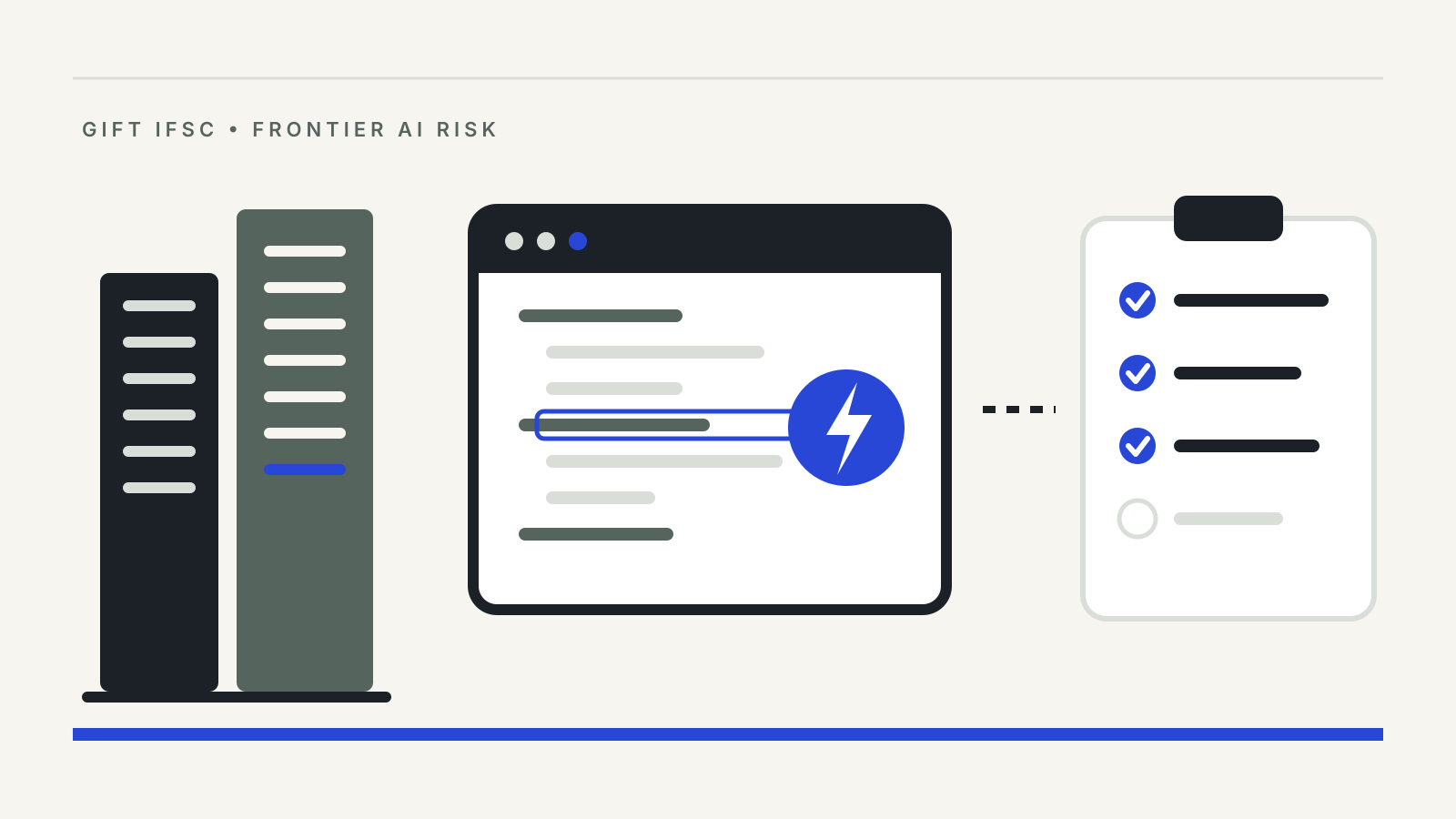
India’s banks answer to the RBI on AI and its brokers answer to SEBI. Firms in GIFT City’s International Financial Services Centre have their own regulator, and its AI circular is about defence rather than adoption. The IFSCA AI circular of 4 June 2026 tells every regulated entity in the IFSC to prepare for attackers who use frontier AI models to find and exploit software flaws within hours.
This explainer covers what the circular says, which of its measures are mandatory in tone, how it sits with IFSCA’s earlier cyber rules, and what the regulator’s own survey shows about AI use in GIFT City.
What the circular is
The Advisory on Heightened Cyber Security Risks arising from Frontier Artificial Intelligence Models, circular IFSCA-CSD/MSC/3/2026-DCS, was issued by IFSCA’s Division of Cyber Security on 4 June 2026 under sections 12 and 13 of the International Financial Services Centres Authority Act, 2019. It took effect immediately and is addressed to all regulated entities in IFSCs: banking units, fund managers, brokers, insurers, leasing companies and others.
IFSCA’s reasoning is set out in two paragraphs. Frontier models, it says, can analyse large codebases, find known and previously unknown (zero-day) vulnerabilities, reason about whether they can be exploited and write working exploits, “compressing the time between disclosure of a vulnerability and its exploitation from weeks to hours”. The most capable models are under restricted availability for now, but IFSCA expects the capabilities to spread quickly, so firms should strengthen their security before that happens.
How it fits with the existing cyber rules
The advisory does not replace anything. It is to be read with IFSCA’s Guidelines on Cyber Security and Cyber Resilience for Regulated Entities, issued on 10 March 2025 and amended on 10 March 2026, and with the separate guidelines for market infrastructure institutions issued on 20 April 2026. The circular states that it “does not dilute any obligation thereunder”.
The wording needs care. Paragraph 4 says regulated entities “are encouraged to comply” with the measures in Annexure A. Inside the annexure, however, seven of the eleven measures use “shall” and four use “encouraged”. A compliance team will read the “shall” items as the regulator’s firm expectation.
The 11 measures
| No. | Measure | Wording |
|---|---|---|
| 1 | Presume newly disclosed critical vulnerabilities are exploitable within hours; prepare for “patch waves” | shall |
| 2 | Add frontier-AI risk as a defined scenario in cyber risk assessments, reviewed by the board (or the technology committee of a market infrastructure institution) | shall |
| 3 | Keep a software bill of materials, including open-source components | shall |
| 4 | Use phishing-resistant multi-factor authentication for internet-facing systems and privileged access; change MFA devices only through verified processes | encouraged, with enrolment controls under “shall” |
| 5 | Patch the vulnerabilities most likely to be exploited first | encouraged |
| 6 | Keep an inventory of all APIs, rate-limit them and allow only whitelisted connections | shall |
| 7 | Make critical service providers assess frontier-AI risk and show they are ready for faster exploits | shall |
| 8 | Monitor for signs of AI-driven attacks, such as automated reconnaissance and attack sequences faster than a human could run | shall |
| 9 | Respond to stolen credentials within minutes, with automated resets and lockouts | encouraged |
| 10 | Use AI tools to find vulnerabilities, but only with authorisation, without exposing sensitive data to unapproved services, and on adequate data-handling terms from the model provider | encouraged, with safeguards under “shall” |
| 11 | Keep human oversight of AI-driven fixes and test AI-generated code before production | shall |
Source: IFSCA circular IFSCA-CSD/MSC/3/2026-DCS, 4 June 2026, Annexure A.
Two measures go beyond the firm’s own systems. Item 7 pushes the duty down the supply chain to critical vendors. Item 10 turns the advice back on the defenders: a firm that sends source code, configurations or logs to an outside AI model to look for bugs has to be sure it is allowed to, that regulated data does not leave for unapproved services, and that the provider’s retention and confidentiality terms are adequate. Those are the same questions our guide to AI tools under the DPDP Act raises for employers generally.
What IFSCA’s survey shows
On 30 July 2026 IFSCA published its Artificial Intelligence in IFSC – Survey 2026 Report, based on a voluntary web questionnaire that drew about twice as many respondents as in 2025. The report gives the split by sector but not the total number of respondents, and it warns that voluntary, self-reported answers may overstate adoption. Among its findings:
- 65% of entities were exploring or had implemented generative AI, and 17% were running it in production.
- Operational efficiency was the leading reason for using AI, cited by 82%, up from 64% in 2025.
- Use of vendor or off-the-shelf tools rose from 23% to 44%.
- Data privacy and protection was the top technical concern, at 74%.
- Formal AI audit was reported by 35%, up from 10%.
- Employees used public AI tools at 57% of entities, up from 52%.
- 48% wanted clarity on how existing rules apply to AI, and 46% asked for principles-based guidance.
The survey describes human-in-the-loop review as the most common safeguard for AI in production. The rise in vendor tools and staff use of public AI services is relevant to the circular: the more a firm relies on outside models and platforms, the more items 7 and 10 apply to it.
What it means
For GIFT City entities, the circular sets the agenda for the next board review of cyber risk: an SBOM, an API inventory, vendor attestations and a written scenario for AI-speed attacks. Firms should check the exact text against their own licence category and the March 2025 guidelines.
For readers outside GIFT City, the circular is a marker of how Indian financial regulators are approaching AI. The RBI’s FREE-AI framework and SEBI’s AI/ML rules focus on how firms use AI in decisions about customers. IFSCA’s circular deals with AI as an attacker’s tool. Separately, organisations in India that suffer a cyber incident must tell CERT-In under its six-hour reporting rule.
Sources
International Financial Services Centres Authority, circular IFSCA-CSD/MSC/3/2026-DCS, “Advisory on Heightened Cyber Security Risks arising from Frontier Artificial Intelligence Models”, 4 June 2026, with Annexure A. IFSCA, “Artificial Intelligence in IFSC – Survey 2026 Report”, 30 July 2026. IFSCA circulars on Guidelines on Cyber Security and Cyber Resilience dated 10 March 2025, 10 March 2026 (IFSCA-CSD/MSC/1/2026-DCS) and 20 April 2026 (IFSCA-CSD/MSC/2/2026-DCS), as cited in the June 2026 circular. Documents consulted on 16 October 2026.