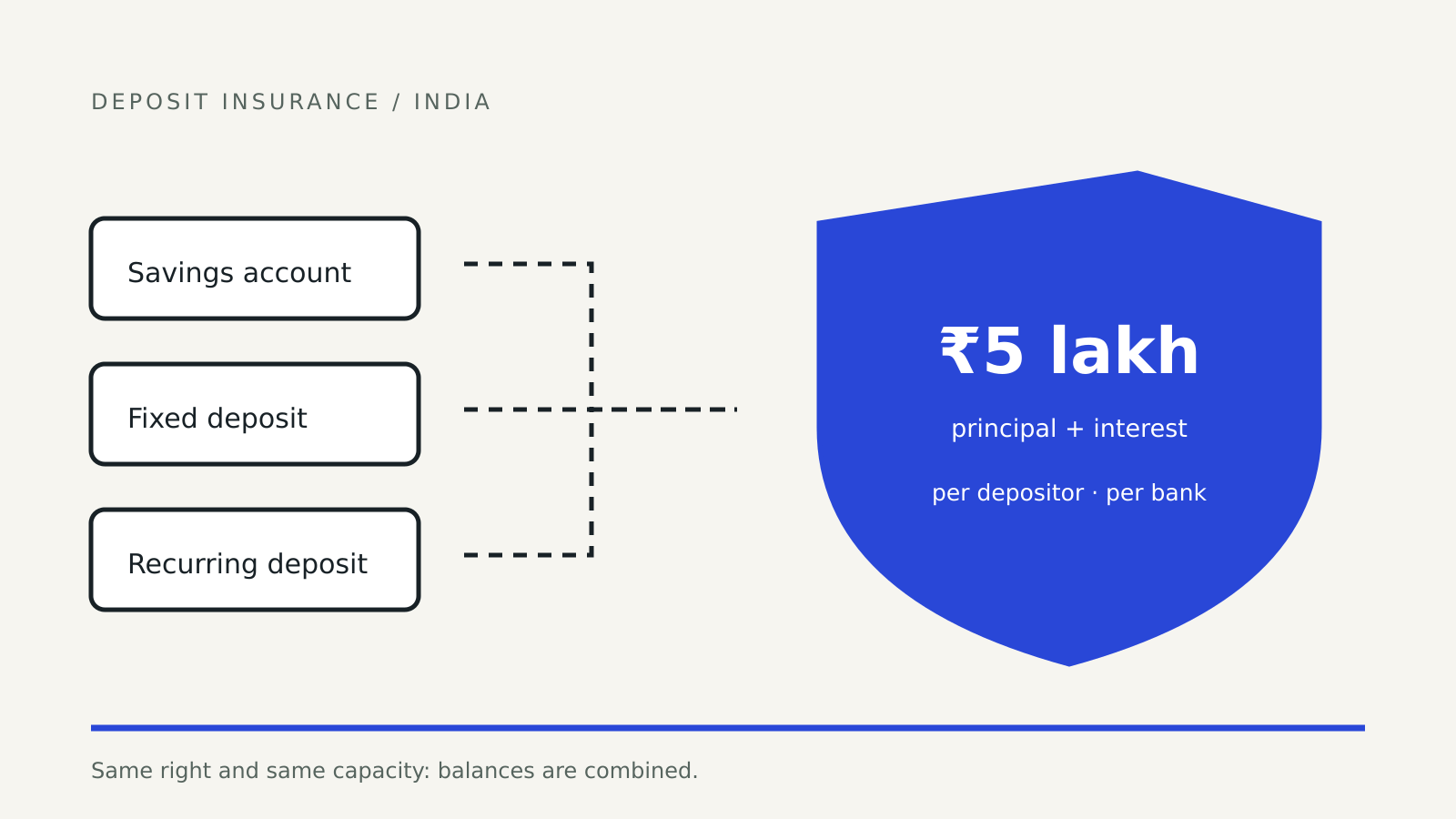
DICGC deposit insurance covers up to ₹5 lakh for each depositor at each insured bank, counting principal and interest together. Savings accounts, fixed deposits and recurring deposits held in the same right and capacity at that bank are combined. Opening another account or using a different branch of the same bank does not create another ₹5 lakh limit.
That is the rule worth checking before treating several account balances as separately protected. The bank, the ownership of the account and the type of product matter more than the number of deposit receipts.
What DICGC protects
The Deposit Insurance and Credit Guarantee Corporation is a wholly owned subsidiary of the Reserve Bank of India. Its insurance covers eligible deposits at insured banks.
DICGC lists savings, fixed, current and recurring deposits among the covered types. It says commercial banks, including branches of foreign banks operating in India, local area banks and regional rural banks, are insured. Co-operative banks are covered too; primary co-operative societies are not.
The distinction between a bank and another financial business is important. DICGC explicitly excludes deposits mobilised by non-banking financial companies. A product using the word “deposit” is not automatically an insured bank deposit.
The insurer publishes a list of insured banks. If you are unsure about a particular institution, check the official list and ask the branch to confirm its insured status. Do not rely only on an app’s name or a sales message.
The ₹5 lakh limit includes interest
The ceiling applies to principal and accrued interest together. It is not ₹5 lakh of principal plus an unlimited amount of interest.
DICGC gives this example: ₹4,95,000 of principal and ₹4,000 of accrued interest make an insured total of ₹4,99,000. If the principal itself is already ₹5 lakh, additional interest falls above the ceiling.
Here is another illustrative calculation, not a bank quote:
| Deposit at one bank, same ownership | Balance including interest |
|---|---|
| Savings account | ₹1,20,000 |
| Fixed deposit | ₹3,50,000 |
| Recurring deposit | ₹80,000 |
| Combined deposits | ₹5,50,000 |
| Maximum insured amount | ₹5,00,000 |
| Amount above the limit | ₹50,000 |
The insurance calculation combines the deposits before applying the ceiling. It does not apply a separate ₹5 lakh cap to every row.
The FD calculator can help estimate maturity values, but a maturity calculation is not an insurance determination. Include accrued interest when reviewing how much you hold at the bank.
Different branches do not mean different banks
Accounts at separate branches of the same bank are aggregated for deposit insurance when held in the same right and capacity.
For example, a savings account opened near home and an FD opened through the bank’s app do not become separately insured because their account numbers or servicing branches differ.
DICGC says deposits at different banks are separately insured. The relevant distinction is the bank, not the branch or the interface used to open an account.
Before drawing a conclusion, identify the legal bank holding the money. A familiar brand, a partner app and the institution named in the account documents may play different roles.
What “same right and same capacity” means
The phrase describes the legal ownership in which money is held. DICGC’s FAQ explains that an individual’s savings, current, fixed and recurring deposit accounts at the same bank are normally grouped together.
Accounts held in a genuinely different capacity can receive separate treatment. DICGC gives examples including a guardian for a minor, a partner of a firm, a trustee and joint ownership.
There is an important exception for sole proprietors: deposits in a proprietary concern and the proprietor’s individual deposits are aggregated. A business name alone does not create a separate insurance entitlement.
Joint accounts also have specific grouping rules. Accounts held by the same people in the same order are combined. DICGC describes different treatment where the order of names or the group of holders differs. Check the official rules against the actual account records rather than assuming every joint account creates extra cover.
What is outside the cover
DICGC’s consumer guide lists several products outside deposit insurance:
- NBFC deposits;
- mutual funds;
- stocks and bonds;
- exchange-traded funds;
- cryptocurrencies;
- deposits mobilised by land development banks.
It also excludes certain categories of bank deposits, including government and inter-bank deposits and deposits received outside India.
A mutual fund or bond bought through a bank does not become an insured deposit just because the bank distributed it. The product’s legal form matters.
Insurance also does not compensate for every way money can be lost. A scam payment or an unauthorised transaction is not the same event as a bank entering the circumstances that trigger a deposit-insurance claim. For transaction problems, see our explanation of unauthorised electronic banking transaction liability and use the bank’s reporting channel promptly.
When payment becomes due
Deposit insurance is not an on-demand withdrawal service. Claims arise through specified events such as liquidation, reconstruction or amalgamation, and certain RBI restrictions on withdrawals.
For a bank placed under All-Inclusive Directions, DICGC describes a statutory process intended to settle eligible claims within 90 days. The bank must supply depositor information within 45 days; verification and payment stages follow. The insurer warns that delayed or missing information from the bank can constrain settlement.
Depositors in that situation are asked to approach the bank’s CEO or administrator and submit a signed willingness form with the required identity documents. Follow the notice for the specific bank rather than applying a general timeline to every case.
In liquidation, the liquidator prepares the depositor-wise claim list and submits it to DICGC. The insurer pays the liquidator, who disburses the amount to eligible depositors. This is a different route from the process for a bank under withdrawal restrictions.
A practical check of your deposits
A useful review starts with records, not an advertised interest rate:
- Identify the legal bank holding each deposit.
- Confirm that it is insured by DICGC.
- Group accounts at all branches by the relevant ownership and capacity.
- Add principal and accrued interest.
- Check whether any dues to the bank must be set off.
- Keep account details, identity records and nominee information current.
- If restrictions are imposed, read the bank-specific DICGC and RBI notices.
The insured bank pays the deposit-insurance premium. DICGC’s information leaflet says that cost cannot be passed on to depositors.