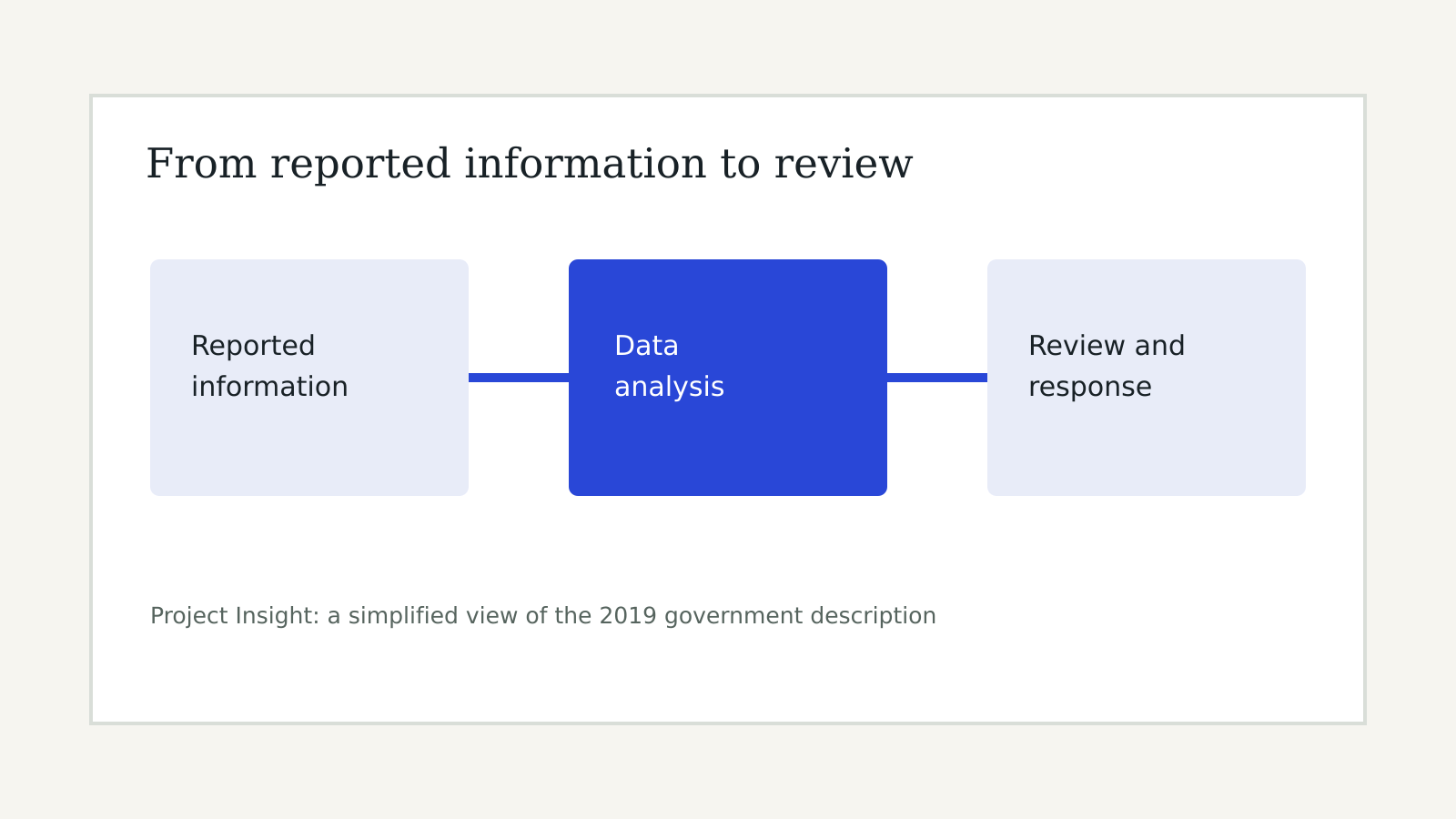
Project Insight is an Income Tax Department data warehousing and analytics project intended to help India’s tax administration use information more effectively. In a 2019 parliamentary reply, the Ministry of Finance said its platform brought departmental data sources together and supported work such as identifying high-risk non-filers and selecting cases for scrutiny.
That description explains the project’s stated purpose at the time. It does not establish that every mismatch leads to a notice, that every decision is made by artificial intelligence, or that a transaction appearing in a tax statement is automatically taxable.
What the government said Project Insight does
The Ministry’s July 2019 reply described Project Insight as an integrated data warehouse and business-intelligence platform. Its stated goals were to encourage voluntary compliance, deter non-compliance and support fair tax administration.
The ministry said the data warehouse had been implemented with end-of-day integration of key departmental projects and data sources. It also described the Income Tax Transaction Analysis Centre, or INTRAC, as handling data integration, quality, enrichment and analytics.
Those are the government’s descriptions of the system in 2019. They are not a current inventory of every dataset or a description of every method now in use. The reply does not say that every function runs without human review.
Reporting and compliance portals
The same reply described two interfaces. A reporting portal gave reporting entities a way to submit information and address data quality or rectification. A compliance portal was intended to collect structured responses to compliance issues.
These serve different users. A reporting entity supplying information is not the same thing as an individual taxpayer responding to a question about their own records. Nor does receiving an electronic communication by itself prove that tax is owed. Read the actual communication and the relevant records before responding.
The 2019 reply described a phased rollout and a planned completion in that year. Treat that as the government’s historical statement rather than a new announcement about current implementation.
What a taxpayer can check in AIS
The Income Tax Department’s current Annual Information Statement FAQ describes AIS as a view of information available to a taxpayer, with an online feedback facility. Its categories include tax deducted or collected at source, reported financial transactions, tax payments and other information.
AIS is a reader-facing statement, not a public view into every Project Insight decision. The department says information may be missing from AIS and expects taxpayers to check their records and file complete, accurate returns.
To view it, the department says to sign in at the income-tax portal and use the Annual Information Statement menu, or the e-File route described in its FAQ. The statement can be downloaded in PDF, JSON or CSV.
For the differences among the statement, the Taxpayer Information Summary and Form 26AS, see AIS vs Form 26AS.
What to do with an entry that looks wrong
Compare the reported entry with the records you have, such as a bank statement, tax certificate or transaction confirmation. Check the financial year and the identity of the reporting source. A mismatch can have several explanations; do not assume it is an accusation or simply ignore it.
The department’s FAQ says feedback can be submitted on active information in the TDS/TCS, financial transaction and other-information sections. Select the relevant item, choose the appropriate feedback option and submit the details. The department says the feedback and modified value are then displayed alongside the reported value, and an acknowledgement can be downloaded.
Giving feedback does not replace checking your return. If the issue is complex or a notice requires a response, consider speaking to a qualified tax professional and follow the instructions and deadlines in the notice.
What the sources do not say
Data analytics can mean many techniques, from combining records and applying rules to more complex analysis. The government’s 2019 description calls Project Insight a data-warehousing and business-intelligence project; it does not support a claim that every selection is made by a particular AI model.
The department’s AIS FAQ also says the statement may not contain all relevant transactions. Use it as one input alongside your own records, not as a guarantee that a return is complete.