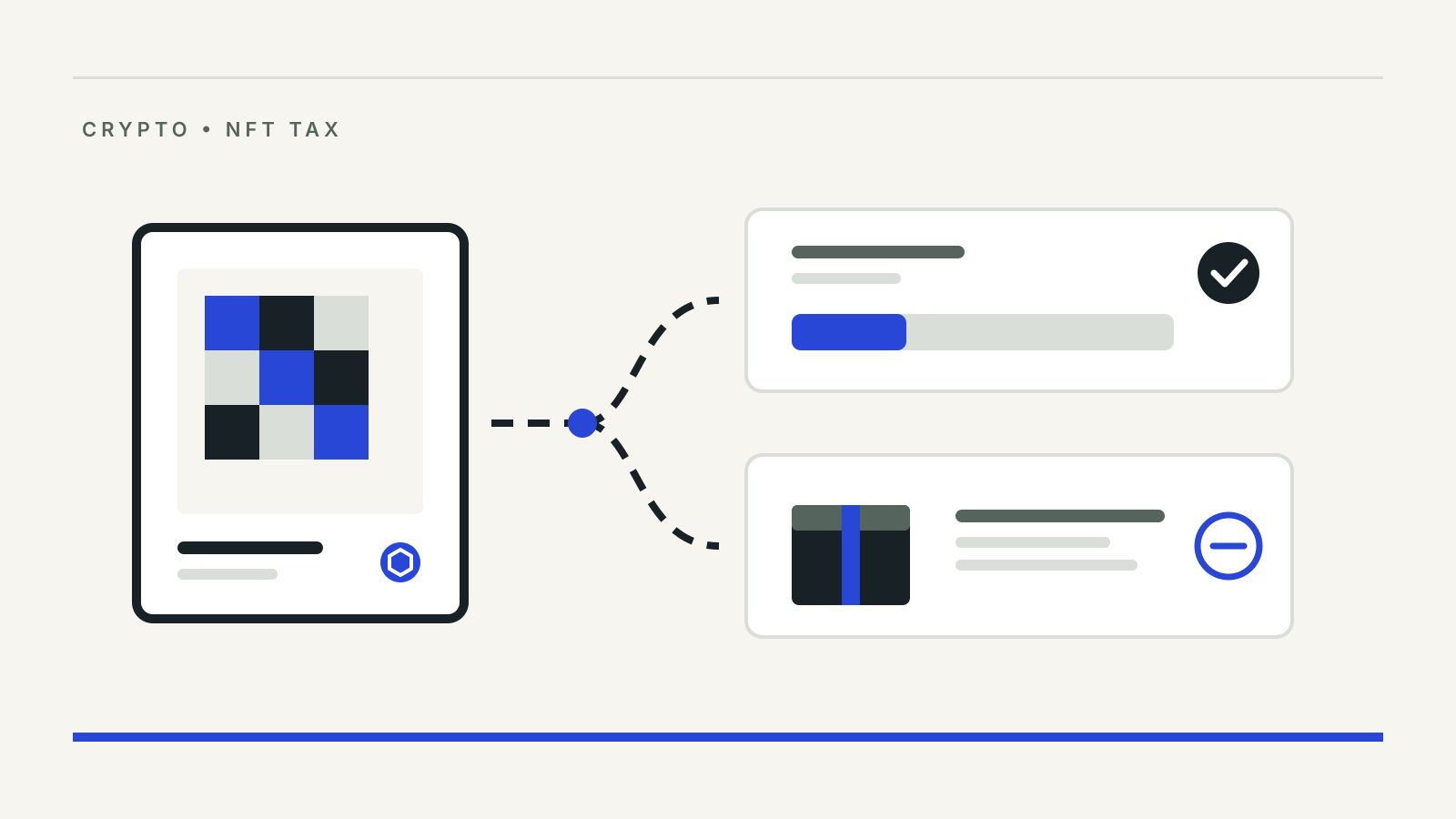
NFT tax in India turns on one question: is the token a virtual digital asset (VDA)? If it is, any income from transferring it is taxed at a flat 30%, only the purchase cost can be deducted, and a loss on it cannot be set off or carried forward. Most NFTs sold as digital art, collectibles or in-game items are inside that net. The main exception, set by a government notification in 2022, is a token whose transfer legally hands over ownership of a physical asset.
What the law says an NFT is
The Income-tax Act, 2025, in force from 1 April 2026, defines a virtual digital asset in section 2(111). The definition has four limbs. The first covers any information, code, number or token, other than Indian or foreign currency, that provides “a digital representation of value” and “can be transferred, stored or traded electronically”. The second names “a non-fungible token or any other token of similar nature, by whatever name called”. The third lets the Central Government notify other digital assets, and the fourth covers any crypto-asset that relies on “a cryptographically secured distributed ledger or a similar technology”.
The Act does not describe an NFT in technical terms. It says “non-fungible token” means “such digital asset as the Central Government may, by notification, specify”, and it gives the government a separate power to exclude any digital asset from the VDA definition. The same structure sat in section 2(47A) of the Income-tax Act, 1961, which governed sales up to 31 March 2026.
The 2022 notifications: what is in and what is out
The government used both powers on 30 June 2022.
Notification No. 75/2022 (S.O. 2959(E)) specifies as a non-fungible token “a token which qualifies to be a virtual digital asset” under the first limb of the definition, “but shall not include a non-fungible token whose transfer results in transfer of ownership of underlying tangible asset and the transfer of ownership of such underlying tangible asset is legally enforceable”.
Notification No. 74/2022 (S.O. 2958(E)), published in the Gazette of India the same day, excludes three kinds of record from the VDA definition altogether: gift cards and vouchers; mileage, reward and loyalty points given without direct monetary consideration; and subscriptions to websites, platforms or applications.
The Income Tax Department’s current page on the taxation of VDAs still lists both notifications. Under “excludes” it names “Physical NFT [Notification No. 75, dated 30-06-2022]” alongside gift cards, reward points and subscriptions.
Which side of the line your token is on
Read together, the rules sort NFTs roughly like this:
| Token | Treated as a VDA? | Why |
|---|---|---|
| Digital artwork, collectible or profile-picture NFT | Yes | A token carrying a digital representation of value, tradable electronically |
| In-game item minted as an NFT and tradable on a marketplace | Yes, if it meets the same test | The label “in-game” does not change the definition |
| NFT whose transfer legally transfers ownership of a physical item, such as a watch or a property interest | No | Excluded by Notification No. 75/2022 |
| Gift card, voucher or loyalty points issued as a token | No | Excluded by Notification No. 74/2022 |
Source: section 2(111), Income-tax Act, 2025; Notifications No. 74 and 75 of 2022, CBDT.
The physical-asset exception is narrow. It applies only where the token’s transfer results in a transfer of ownership of the underlying tangible asset and that transfer “is legally enforceable”. An NFT that merely depicts a physical object, or comes with a promise of perks, does not meet that test on the notification’s wording. Where the exception does apply, the special VDA rules below do not; the tax treatment then follows the asset itself.
How a taxable NFT is taxed
From tax year 2026-27, section 194 of the 2025 Act (Table entry 4) taxes “any income from the transfer of any virtual digital asset” at 30%, for any person. The conditions are the same as for cryptocurrencies:
- no deduction for any expenditure “other than cost of acquisition, if any”, and no allowance;
- no set-off of a loss in computing this income, and no set-off of a VDA loss against any other income;
- the loss “shall not be allowed to be carried forward to succeeding tax years”.
The section applies the Act’s meaning of “transfer” to a VDA “whether capital asset or not”. So it does not matter whether you hold an NFT as an investment or sell them as a creator or trader. The department’s VDA page notes that surcharge and cess are added to the 30%. For sales up to 31 March 2026, section 115BBH of the 1961 Act set the same 30% rate and the same limits.
The buyer side matters too. Section 393(1) of the 2025 Act, Table entry 8(vi), requires a person paying consideration for the transfer of a VDA to a resident to deduct tax at 1%, subject to small-value thresholds. Our guide to crypto tax in India sets out those thresholds and how the TDS is credited against the final tax.
Gifts, swaps and reporting
Section 92 of the 2025 Act treats a VDA received as a gift like other gifted property: once the total value of such gifts in the tax year crosses ₹50,000, the whole amount is taxed in the recipient’s hands, unless the gift comes from a relative or another exemption applies, according to the department’s guide to the tax treatment of gifts. Our explainer on crypto gift tax in India works through examples.
Every transfer of a VDA, including an NFT sold for another token, is listed separately in Schedule VDA of the return. The ITR-2 form notified for assessment year 2026-27 in Notification No. 46/2026 treats “every ‘transfer’” as a transaction, and our Schedule VDA guide walks through the columns.