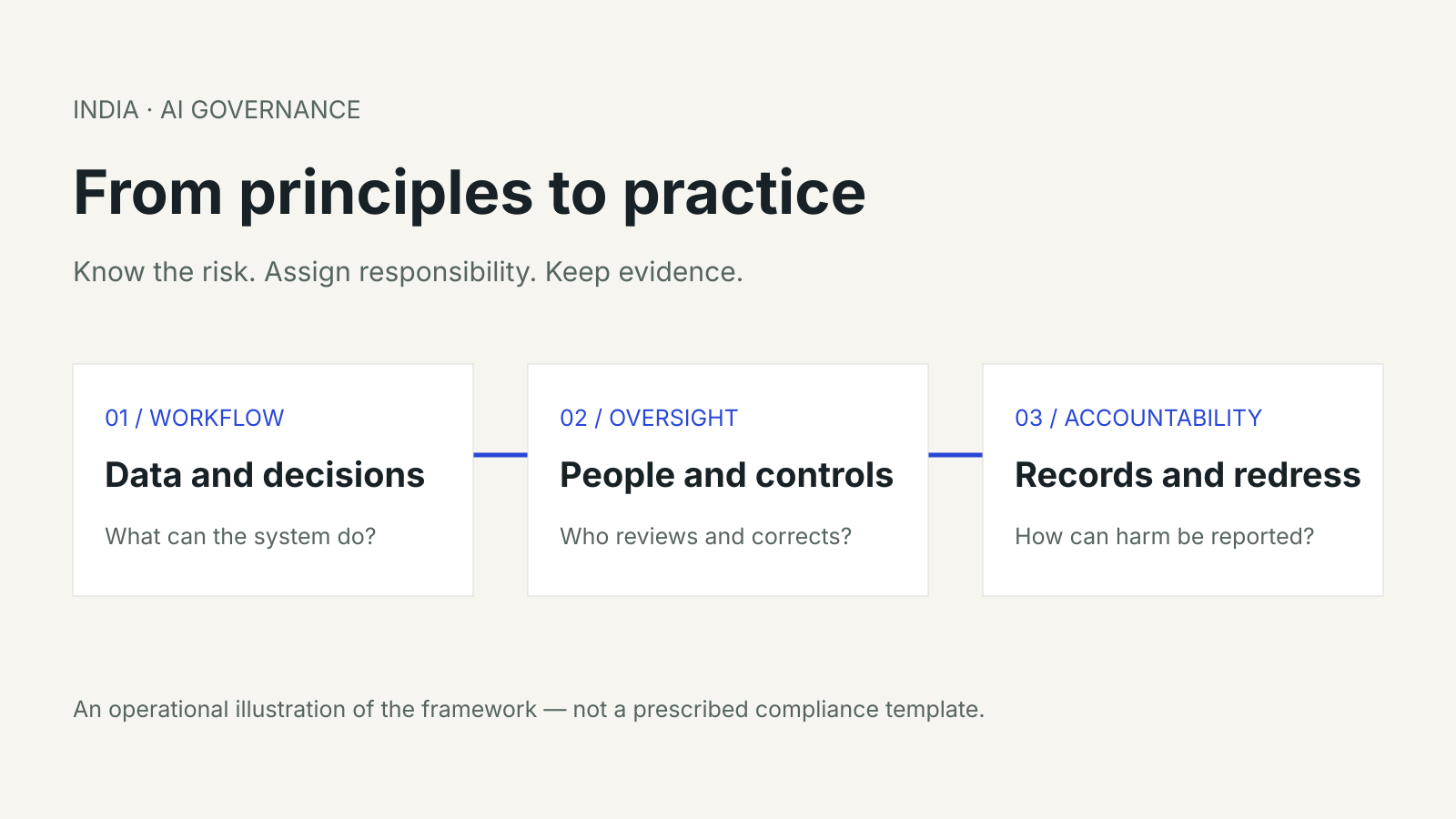
India’s AI governance guidelines set out principles and practical expectations for developing and deploying AI. They favour proportionate safeguards, transparency and accountability, while relying on applicable laws rather than creating a universal AI licensing requirement.
For an Indian company using AI in customer support, recruitment or document processing, the useful question is what those expectations mean inside a workflow. Who checks the output? What happens when someone is harmed? Which records show how a decision was made?
MeitY announced the guidelines on 5 November 2025. This is an explanation of the framework and its subsequent institutional development, not a new launch announcement.
How the framework is organised
The government’s description divides the framework into four parts: seven guiding principles, recommendations across six governance pillars, a phased action plan, and practical guidance for industry and regulators.
The seven principles address trust, human interests, innovation, fairness, accountability, understandable systems, and safety with resilience and sustainability. Their role is to guide decisions across different applications. A low-stakes drafting assistant and a system influencing access to an essential service do not present identical risks.
The six pillars cover infrastructure, capacity building, policy and regulation, risk mitigation, accountability, and institutions. The PIB’s February 2026 explanatory paper connects these pillars to measures such as training, risk assessment, technical standards and coordination between public bodies.
It is important to read a recommendation as a recommendation. A proposed national incident database or a future standard should not be described as a fully operating service merely because it appears in the action plan.
What the industry guidance actually asks for
The practical section addresses people and organisations developing or deploying AI systems in India. It asks them to comply with applicable Indian laws and demonstrate compliance when relevant agencies or sectoral regulators require it.
It also recommends voluntary measures concerning privacy, security, fairness, inclusion and transparency. Other recommendations include a grievance mechanism for AI-related harms, transparency reports evaluating risk in the Indian context, and technical approaches to reduce those risks.
These expectations apply to the organisation putting AI to work, not only the laboratory developing a foundation model. Buying access to a model does not answer how a company uses customer data, reviews consequential outputs or handles complaints.
The guidelines do not by themselves determine every company’s legal obligations. The relevant activity, sector and applicable rules still matter. A framework’s recommendation and a binding sectoral requirement should be identified separately.
Turn a principle into a checkable process
A practical starting point is to map the workflow from data collection to the action taken. This is an editorial implementation example, not a government-prescribed checklist.
For a customer-service assistant, the map might include the documents it can retrieve, the information customers enter, whether responses are reviewed, and whether the assistant can change an account or only explain a policy.
| Framework concern | An operational question |
|---|---|
| Privacy and security | What information enters the system, and who can access it? |
| Fairness and inclusion | Which languages and customer situations were considered? |
| Transparency | Can a user understand the system’s role and limitations? |
| Accountability | Who owns a complaint and can correct an error? |
| Risk mitigation | Which outputs require human review before action? |
The map should distinguish a plausible-sounding answer from an authorised action. An assistant drafting a reply has a different consequence from software sending it automatically or applying a decision to a customer.
Human review also needs a defined role. A person who lacks the underlying documents, time or ability to overturn an output cannot provide the same safeguard as a reviewer with those resources.
Evidence matters more than a statement of principles
The framework’s accountability discussion recognises that enforcement requires visibility into organisational practices and the AI value chain. Its practical guidance recommends transparency reports examining potential harm to individuals and society in the Indian context.
For a business, useful supporting records may include the system’s intended purpose, evaluation conditions, known limitations, responsible team and handling of reported problems. These are examples of evidence a company can maintain; the guidelines do not impose a single universal document template.
If a report contains sensitive or proprietary information, the government’s explanatory paper says it should be shared confidentially with relevant regulators. Publishing confidential data indiscriminately is not the objective of transparency.
Likewise, an evaluation should reflect the use case. Accuracy on a general benchmark cannot establish that a system handles an Indian customer’s language, document format or dispute correctly.
What changed institutionally in 2026
The initial recommendations included an inter-ministerial coordination mechanism. On 16 April 2026, MeitY announced the constitution of the AI Governance and Economic Group, or AIGEG.
The announcement describes it as a high-level body for national AI governance policy development and coordination. It links its creation to the guidelines and the Economic Survey, including coordination around labour-market impacts.
The same announcement says a Technology and Policy Expert Committee will support the group with advice. That is a statement about institutional support, not evidence that every proposed standard, reporting channel or technical programme has already been implemented.
What companies should avoid assuming
There is no basis in these documents for saying that every Indian AI product requires a new central licence. The guidance for regulators specifically favours proportionate policy instruments and discourages burdensome approval or licensing requirements unless necessary.
That does not remove obligations under applicable law. Nor does voluntary adoption of a code automatically prove legal compliance or eliminate liability.
For teams deciding how to deploy an AI tool, the framework provides a way to ask better questions about harm, oversight and evidence. Specific legal duties require checking the rules governing the actual activity and their current applicability. Read more workplace coverage in AI & Work.
Sources
MeitY via PIB: guideline launch announcement, 5 November 2025; PIB Research Unit: AI governance explanatory paper, 15 February 2026; MeitY via PIB: AIGEG constitution announcement, 16 April 2026. Documents consulted on 7 October 2026; links appear beside the relevant discussion.