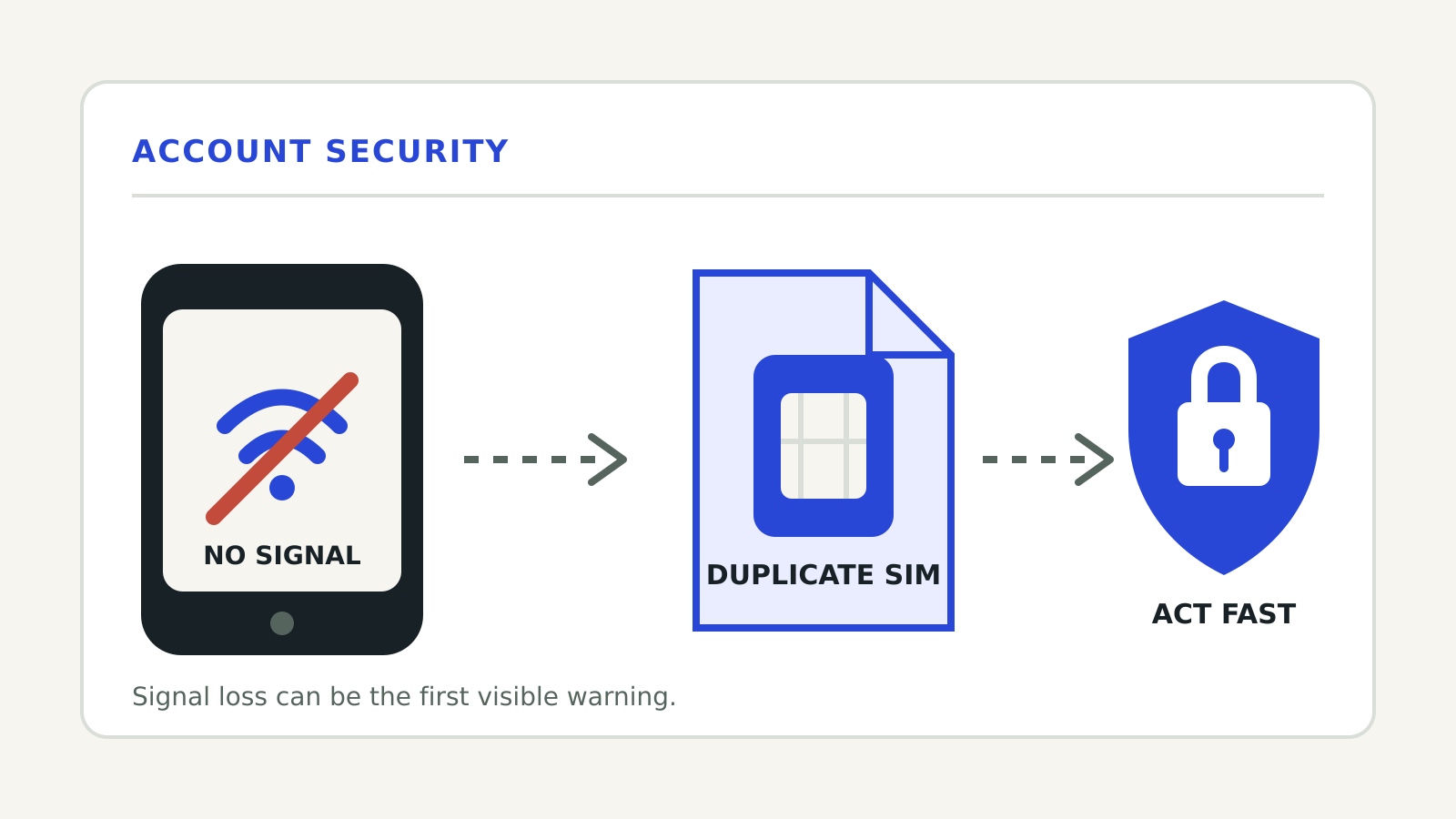
A phone that suddenly shows No Service can be a routine network problem. It can also be the first visible sign of an unauthorised SIM replacement. The difference matters because control of your mobile number can help a fraudster receive calls or SMS one-time passwords.
Do not wait for a debit alert to investigate. Contact your mobile operator through its official support number or a store, then secure the accounts that use the number for recovery.
What a SIM swap changes
In a SIM-swap attack, a fraudster persuades or deceives a telecom provider into activating a replacement physical SIM or eSIM for your number. Once that replacement becomes active, your legitimate SIM may lose service. Calls and messages can then reach the new SIM.
That does not automatically reveal every password or defeat every security control. The danger is that many banks, email providers and apps still use the mobile number for one-time passwords, alerts or account recovery. A criminal may combine the number takeover with personal information gathered elsewhere.
Warning signs include:
- an abrupt loss of mobile signal while people nearby still have normal service;
- an unexpected message about a replacement SIM, eSIM activation or porting request;
- password-reset or new-device alerts you did not initiate;
- calls from contacts saying your number behaved differently;
- bank alerts for transactions or account changes you do not recognise.
A single sign is not proof. Treat several signs together, or a service loss followed by account alerts, as urgent.
What to do first
1. Call the telecom operator from another phone
Use the number on the operator’s official website or app, not a number sent in an unsolicited message. Ask whether a SIM replacement, eSIM activation or porting request was made. If it was unauthorised, request an immediate block and restoration of your number. Keep the complaint or service-request number.
2. Tell your bank immediately
Use the bank’s official app, website, branch or published helpline. Ask it to freeze affected digital access and cards where necessary, flag disputed transactions and record when you reported the incident. Save the acknowledgement.
The Reserve Bank of India’s Customer Protection – Limiting Liability of Customers in Unauthorised Electronic Banking Transactions, dated 6 July 2017, requires banks to provide 24-hour reporting channels and to act immediately after a report. For qualifying third-party breaches, reporting within three working days can mean zero customer liability; the position changes with delay or customer negligence. Read our guide to liability for unauthorised electronic banking transactions for the conditions and timelines.
3. Report financial cyber fraud
For a financial cyber-fraud incident in India, call 1930 as soon as possible and complete the complaint at the National Cyber Crime Reporting Portal. Keep the acknowledgement number, screenshots and transaction references.
Suspicious calls, messages or WhatsApp accounts that have not yet caused a financial loss can also be reported through Chakshu on the Sanchar Saathi portal.
4. Secure your email before less important accounts
From a trusted device, change the password for the email account used for recovery. Review active sessions, forwarding rules, recovery addresses and registered phone numbers. Then change the credentials for financial and other sensitive accounts. Where a service supports it, prefer an authenticator app, passkey or hardware security key over SMS alone.
What Indian telecom rules require
The Department of Telecommunications announced safeguards for SIM replacement in August 2023. They include complete know-your-customer checks for a replacement SIM and a 24-hour bar on incoming and outgoing SMS after a replacement.
TRAI’s Telecommunication Mobile Number Portability (Ninth Amendment) Regulations, 2024 added another control. From 1 July 2024, a mobile subscriber cannot receive a Unique Porting Code until seven days have passed since a SIM swap or replacement. The rule is meant to reduce fraudulent porting immediately after a number takeover.
These measures reduce opportunities for abuse, but they are not a guarantee that an impersonation attempt will fail. Your fastest practical defence is still to notice the service loss, contact the operator and notify the bank without delay.
SIM replacement is not the same as porting
A SIM replacement keeps your number with the same operator but moves it to a new physical SIM or eSIM. Porting moves the number to another operator and requires a Unique Porting Code. A criminal may attempt one, the other or both in sequence.
That distinction helps when you speak to support. Ask the operator to check for replacement, eSIM activation and porting activity separately.
Reduce the risk before anything happens
- Never share an OTP, PIN, password or SIM serial number with an unsolicited caller.
- Do not install an app or scan a QR code because someone claims your KYC will expire.
- Open your operator or bank app directly instead of following a message link.
- Enable email as well as SMS alerts for important account changes.
- Review devices and recovery methods on your primary email account.
- Use a strong screen lock and keep the phone’s operating system updated.
- Check the mobile connections issued in your name through Sanchar Saathi.
- If Aadhaar is not needed for an imminent transaction, consider the Aadhaar biometric lock and understand when you will need to unlock it.
Official sources
- Department of Telecommunications: citizen-centric reforms for SIM replacement and mobile connections
- TRAI: Telecommunication Mobile Number Portability (Ninth Amendment) Regulations, 2024
- Reserve Bank of India, Customer Protection – Limiting Liability of Customers in Unauthorised Electronic Banking Transactions, 6 July 2017
- Reserve Bank of India, BE(A)WARE: A Booklet on Modus Operandi of Financial Frauds
- National Cyber Crime Reporting Portal
Questions people ask
Can a SIM-swap fraudster read old messages on my phone?
Not from the SIM change alone. The immediate risk is control of new calls and SMS sent to your number, plus any account-recovery process that trusts that number.
Does losing mobile signal prove that my SIM was swapped?
No. Outages and damaged SIMs can cause the same symptom. Contact the operator through an official channel and ask it to check replacement, eSIM and porting activity.
Who should I call first after an unauthorised swap?
Call the telecom operator to block the replacement and your bank to protect financial access. If money has moved or a financial fraud is in progress, call 1930 and complete the complaint at cybercrime.gov.in.