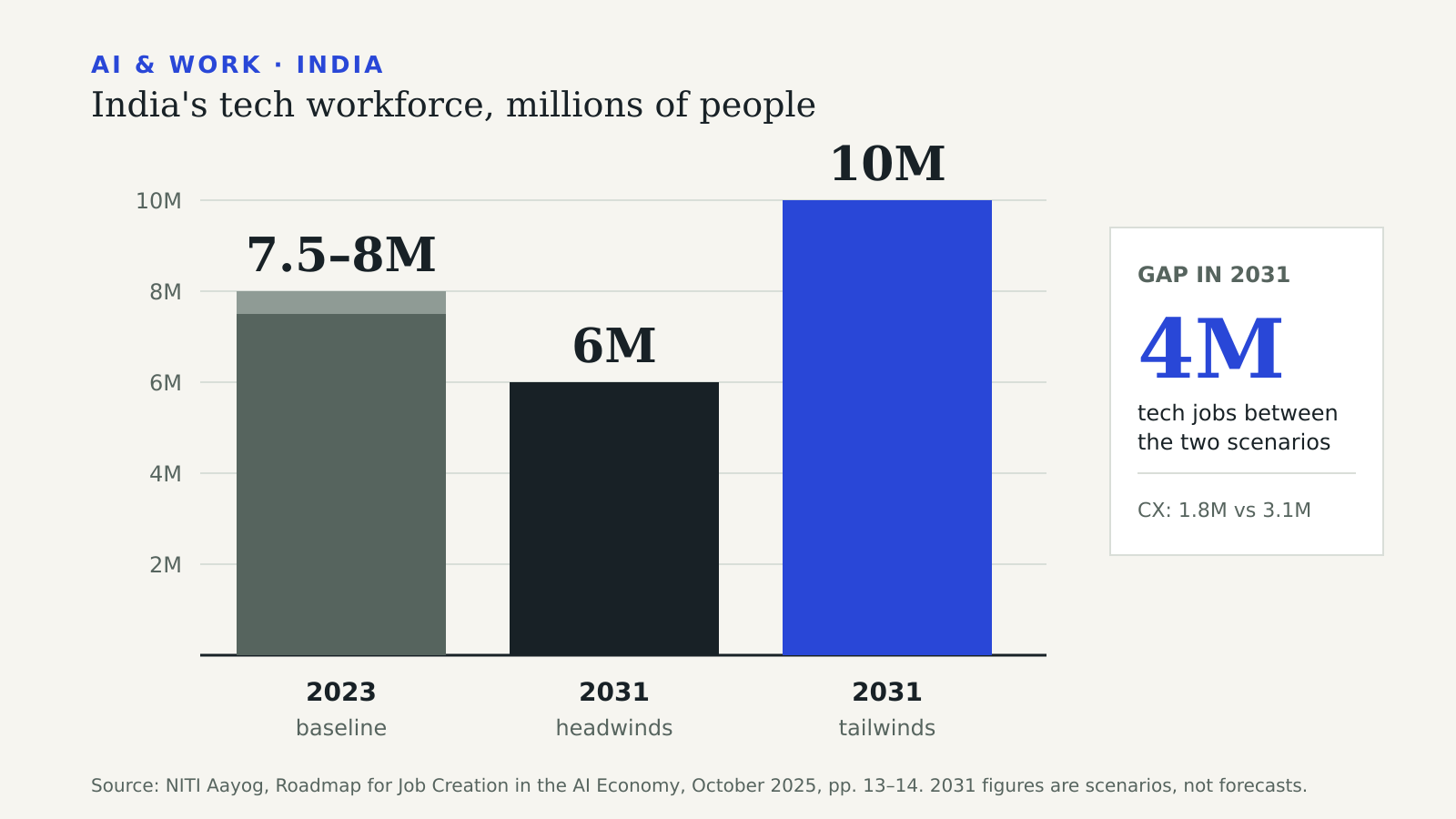
NITI Aayog’s answer to how AI will affect jobs in India is a range, not a single number. Its Roadmap for Job Creation in the AI Economy, published on 9 October 2025, says the country’s tech workforce of 7.5 to 8 million people in 2023 could shrink to 6 million by 2031, or grow to 10 million, depending on what India does now. In the foreword, NITI Aayog’s Debjani Ghosh puts it as a choice: “we could lose 1.5 million jobs or create up to 4 million new opportunities.”
The report looks at what AI means for two large employers of Indian white-collar workers: technology services and customer experience (CX), the contact-centre and support industry. It was developed by NITI Aayog’s Frontier Tech Hub, with BCG and NASSCOM credited as partners. Below is what it projects, which roles it expects to shrink or grow, and what it asks the government to do.
The two 2031 scenarios
The report models two outcomes for 2031 (page 13). In the downside, which the foreword calls the business-as-usual case, three “headwinds” dominate: productivity gains from AI, competition from AI-native firms that work onshore in client countries, and macroeconomic or geopolitical instability. In the upside, “tailwinds” win out: new spending pools, new use cases and technologies, new roles, and more global capability centres (GCCs) in India.
| Workforce | 2023 | 2031, headwinds | 2031, tailwinds |
|---|---|---|---|
| Tech workforce (incl. tech roles outside tech services) | 7.5–8 million | 6 million | 10 million |
| Customer experience (CX) workforce | 2–2.5 million | 1.8 million | 3.1 million |
| Change in tech workforce from 2023 | – | 1.5–2 million fewer | 2–2.5 million more |
Source: NITI Aayog, Roadmap for Job Creation in the AI Economy (October 2025), pages 13–14. The last row is our arithmetic from the report’s ranges.
The gap between the two columns is large: 4 million tech jobs and 1.3 million CX jobs separate the downside from the upside in 2031. The report’s figures are scenarios, not forecasts, and it does not attach a probability to either.
Two numbers in the report do not line up, and readers will see both quoted. The foreword speaks of “up to 4 million new opportunities”. Page 2 says that if India acts, “by 2030, we can add 2 million more new jobs”. The report does not reconcile them. The table above uses the headcount scenarios on page 13, which are the most specific figures it gives.
Which roles shrink, change or appear
The report’s examples of roles (pages 7 and 8) give a clearer picture than the totals. The groupings below are ours:
- Most exposed: the junior QA (testing) engineer, which it describes as on “the path to redundancy”, and the L1 support agent. “AI can replace a human L1 support agent seamlessly,” it says.
- Not singled out for replacement: L2 and L3 support engineers, data architects and full-stack developers appear in the same discussion, but the report does not put them on a path to redundancy.
- New: enterprise roles such as ethical AI specialist, sentiment intelligence analyst, AI stack architect and prompt engineer; frontier roles such as quantum machine-learning engineer and neurohaptic engineer; and researchers and engineers working on AI itself.
It also estimates that AI can raise software development productivity by 10–20% overall, and by 50–60% for straightforward applications (page 4). It also says hiring of entry-level software engineers may slow (page 10).
Where demand already outruns supply
The roadmap argues that India’s problem is as much a talent shortage as a job loss. It puts demand for AI talent at 800,000–850,000 people rising to more than 1.25 million over 2024–26, with supply at about half of demand (page 10). India produces fewer than 500 AI-related PhDs a year, and about 44% of the country’s top AI researchers work abroad (page 16).
Outside the tech sector, it notes that over 60% of formal-sector jobs could be susceptible to automation by 2030, especially in IT and BPO, and that about 400 million Indians work in the informal sector (page 10). It does not model informal jobs in the way it models tech and CX headcount.
What NITI Aayog recommends
The central proposal is an India AI Talent Mission (page 16) with three pillars:
- AI fluency across education, from schools to universities.
- Making India a magnet for global AI talent.
- A large-scale AI skilling engine for people already in work.
Two enablers sit alongside it and are meant to work with the existing IndiaAI Mission: an India open-source AI commons, and a federated national compute and innovation grid. For current workers, the report proposes reskilling routes including flexible AI master’s and doctoral programmes, and wider AI literacy through the national apprenticeship scheme (NAPS) and Pradhan Mantri Kaushal Vikas Yojana (PMKVY) (page 17). Its stated vision is to make India “the global epicentre of AI talent by 2035” (page 15).
The roadmap sets these out as recommendations; it does not itself open any scheme a worker can apply to. Programmes that do exist now are covered in our explainers on IndiaAI FutureSkills and the IndiaAI Mission.
What it means if you work in tech or a contact centre
The report’s own role list suggests where to look first. If your work is mostly first-line support or routine testing, it names those tasks as the easiest to automate. The more senior roles in the same discussion, such as L2/L3 support, data architecture and full-stack work, are not the ones it marks for replacement.
Employers adopting AI tools also take on legal duties that affect staff: the DPDP Act’s rules on using AI at work, and CERT-In’s new AI security audit guidelines for AI systems that companies deploy.