
A stablecoin in a wallet and money available in a bank account are different records. Redeeming an issuer-backed token connects them: an eligible holder follows the issuer’s process to exchange the token for the currency it represents. Selling the token to another trader is a different route, even if the result also ends with money in a bank.
The distinction matters when a business accepts a stablecoin payment and later needs to pay a bill in ordinary currency. A quoted one-dollar value does not describe every fee, access condition or bank transfer involved. USDC provides a documented example, but its arrangements should not be assumed to apply to every stablecoin.
Direct redemption depends on access to the issuer
Circle’s USDC terms for holders outside the European Economic Area, updated 12 December 2025, distinguish holders with a Circle Mint account from holders without one. Under those terms, direct redemption with Circle requires an eligible Mint account in good standing. Holding USDC in an external wallet does not by itself establish that access.
The issuer’s terms describe a commitment to redeem at one US dollar per USDC, subject to the stated conditions and applicable fees. This is an issuer commitment, not a measurement of the price available on every exchange. Circle identifies separate arrangements for EEA holders, so readers should use the terms applicable to their location rather than treating one page as universal.
An individual who cannot redeem directly may use a platform that supports conversion and withdrawal. That introduces another relationship: the platform’s account rules, pricing, bank support and controls. A business considering stablecoin receipts needs to identify its actual exit route before deciding that the balance is as usable as cash in its operating account.
A token transfer and a bank payout have separate statuses
Circle’s minting and redemption documentation separates on-chain transfers, available account balances and payouts to linked bank accounts. An incoming transfer needs the required blockchain confirmations before it is credited. A payout then creates a bank-side operation with its own progress and possible failure states.
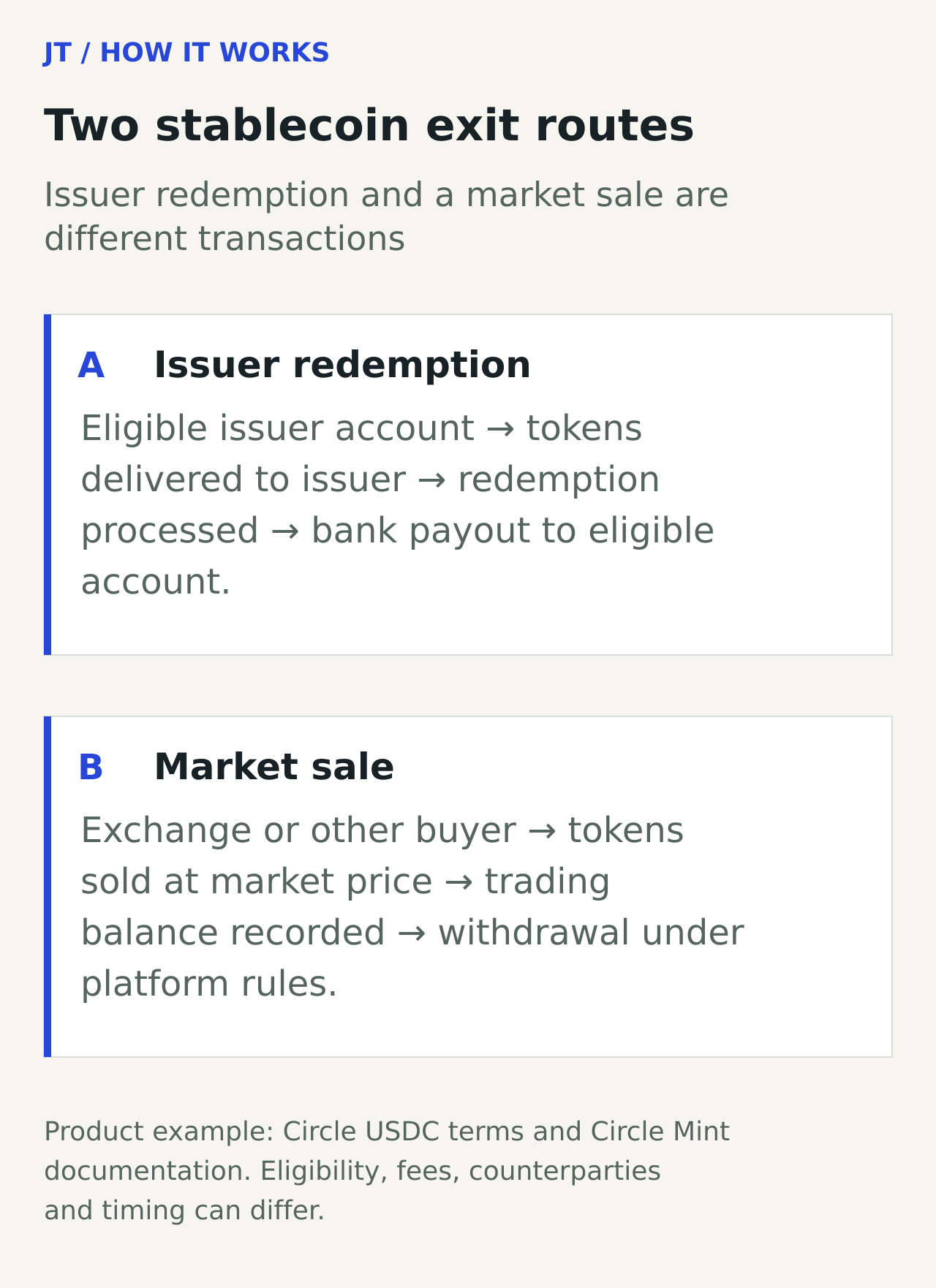
Two possible routes from a stablecoin balance to bank money. The diagram summarises the relationships; eligibility, supported networks, fees and timing depend on the issuer, platform and bank.
The withdrawal guide makes a useful distinction: a completed payout status means funds have been sent to the receiving bank. A wire can still be returned because of bank-side issues such as incorrect details or a beneficiary-name mismatch. That is why a blockchain transaction identifier cannot answer every question about a subsequent bank payment.
For a finance team, the records should connect the incoming token transfer to the conversion and bank receipt. Recording only the number of tokens received leaves the later charges, exchange rate and withdrawal status unexplained. An invoice may be denominated in one currency while the eventual operating account uses another, adding a separate currency conversion to the workflow.
Reserves and market liquidity answer different questions
Circle states that USDC is backed by dollar-denominated reserves held separately from its corporate funds. That statement concerns the issuer’s backing arrangements. It does not tell a holder what another trader will pay for the token at a particular moment, or whether a particular platform will process a withdrawal immediately.
Market liquidity concerns the availability and price of buyers and sellers. Direct redemption concerns the issuer’s obligation and operational process. The two can influence each other, because participants able to move between tokens and currency may respond to price differences, but access, timing and cost can prevent every holder from making the same trade.
Consider a purely illustrative case: a business receives 1,000 tokens intended to track the dollar, sells them through a platform and withdraws to a rupee account. The final amount depends on the sale price, conversion rate, platform charges and banking route. The token’s reference value supplies only one part of that calculation. This example does not describe a current quote or a tested provider.
Check the asset, network and receiving account
A familiar ticker is insufficient to identify the exact asset being transferred. The network and token contract matter, and a platform’s deposit instructions determine what it supports. A bridged representation can introduce an additional arrangement between the token a user holds and the original issuer’s asset. Do not infer direct redeemability from a similar name or logo.
The receiving account matters as much as the sending wallet. A business should verify the beneficiary details and the permitted relationship between the platform account and the bank account. A successful transaction to the wrong blockchain address or an unsupported deposit route can create a recovery problem that the ordinary redemption workflow does not resolve.
Account access creates another dependency. The ability to control a wallet, sign in to a platform and satisfy a bank’s requirements are three different forms of access. Our guide to passkeys and recovery explains why a secure sign-in method should be considered alongside a recovery plan.
Start with the payment you need to make
For a company, the useful question is when it will have the right currency in the account from which its expenses are paid. Work backwards from that requirement: identify the bank destination, available conversion route, eligibility conditions and the token or network the route accepts. Keep the relevant fee and timing information with the transaction plan.
This makes comparisons with conventional payments more concrete. A fast token transfer may be valuable, while the complete workflow still includes a slower bank payout. The UPI long read similarly separates what a user sees in an app from the records and responsibilities behind a payment. Comparing the whole route gives a more useful answer than comparing two isolated confirmation times.
Questions
Is selling a stablecoin the same as redeeming it?
No. A sale transfers it to a buyer or trading platform at an agreed price. Direct redemption follows the issuer’s process and applicable eligibility conditions.
Can every USDC holder redeem directly with Circle?
Under the cited non-EEA terms, direct redemption requires an eligible Circle Mint account. Separate terms apply to EEA holders.
Does a completed blockchain transfer mean the bank money has arrived?
No. Blockchain confirmation and a bank payout describe different stages. Check the receiving bank record as well as the provider’s payout status.
Does a stablecoin automatically pay interest?
No. Circle’s cited terms state that holding USDC does not itself entitle the holder to reserve income. A separate yield product would have its own terms and risks.
Sources
- Circle: USDC terms, non-EEA terms updated 12 December 2025.
- Circle developer documentation: minting and redemption.
- Circle developer documentation: withdraw fiat.
Documentation reviewed 26 September 2026. Explore Crypto coverage or contact the editors about a correction.